
For high-volume e-commerce brands and middle-mile logistics strategists, standard parcel shipping often presents a costly dilemma: national carrier networks charge steep, compound rates as package distance grows, while speed degrades significantly across multi-zone transits.
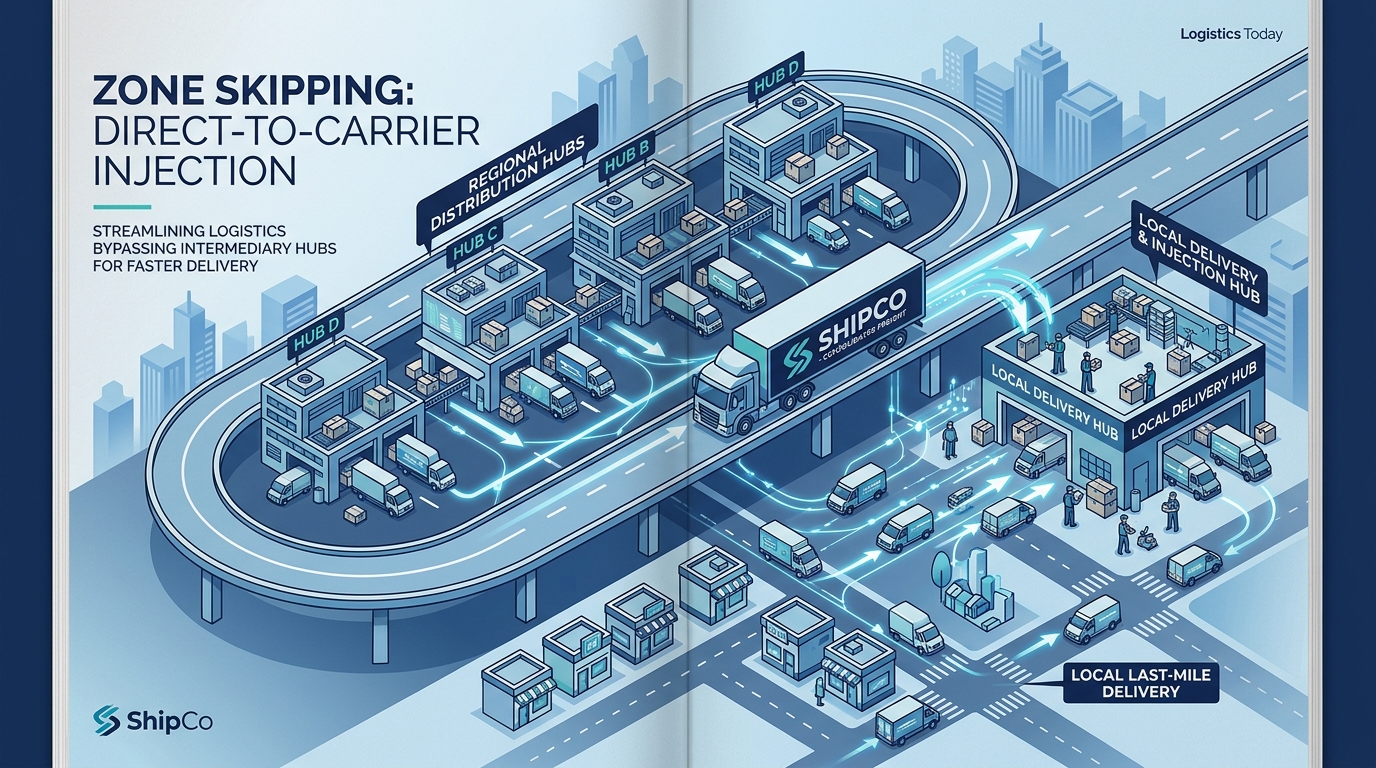
Zone skipping directly bypasses these traditional carrier bottlenecks. By consolidating individual orders into full truckload (TL) or less-than-truckload (LTL) shipments and trucking them straight to regional distribution hubs near end customers, brands achieve lower freight rates, reduced damage risk, and faster order delivery.
How Zone Skipping Works
Traditional carrier networks operate on a hub-and-spoke model. A package shipped from a warehouse in California to a customer in New York moves through numerous regional sorting facilities, incurring incremental costs at each carrier “zone” boundary.
Zone skipping replaces these intermediate stops with direct linehaul transportation.
TRADITIONAL PARCEL ROUTE
[Warehouse] ──> [Zone 2 Hub] ──> [Zone 4 Hub] ──> [Zone 6 Hub] ──> [Zone 8 Hub] ──> [Customer]
                      │                │                │                │
                      └── Multi-Touch Sorting & Cumulative Zone Rate Escalation ──┘

ZONE SKIPPING ROUTE
[Warehouse] ──> [Consolidated Linehaul (LTL / Freight Truck)] ───────> [Zone 2 Regional Hub] ──> [Customer]
                                                                                │
                                                                  Last-Mile Local Injection
The 3-Step Execution Model
- Order Consolidation & Pre-Sorting: Packages destined for a specific geographic region (e.g., the Mid-Atlantic or Upper Midwest) are packed, labeled, and sorted by regional Zip codes right at the fulfillment center.
- Linehaul Long-Haul Transit: Instead of handing individual packages to a national carrier at origin, freight is consolidated into direct truckloads and driven across the country, skipping intermediate carrier sort facilities.
- Destination Injection: The load arrives at a regional carrier terminal or USPS Destination Delivery Unit (DDU) near the recipient. Packages are injected directly into the local stream for final-mile delivery.
Cost & Speed Benefits
| Key Metric | Traditional Parcel Network | Zone Skipping Strategy | Commercial Impact |
|---|---|---|---|
| Zone Pricing | Assessed across 7–8 zones ($$$) | Local rates (Zone 2/3) after injection | 15%–35% lower cost per parcel |
| Transit Time | 4–6 business days | 2–3 business days | Up to 50% speed improvement |
| Package Touches | 5 to 8 sortation points | 2 to 3 total handles | Significantly lower damage rates |
| Surcharges | Peak season & long-haul fuel fees | Direct freight contract rates | Greater rate predictability |
Key Strategic Considerations
While zone skipping offers distinct financial and operational advantages, implementation requires operational scale and precise execution.
- Minimum Volume Thresholds: Freight linehaul carries fixed transportation costs. To achieve positive ROI, brands generally need consistent daily or weekly volume destined for specific geographic clusters.
- Cut-Off & Linehaul Scheduling: Direct freight trucks run on precise schedules. Missing a linehaul window can hold up hundreds of orders simultaneously, requiring rigorous warehouse operations.
- Carrier Integration & Injection API: Successful injection relies on seamless technology integration between warehouse management systems (WMS) and regional or postal injection networks for final-mile tracking visibility.
Optimizing Middle-Mile Fulfillment with ShipLogix
Implementing a multi-zone injection network no longer requires custom freight management software or direct relationships with dozens of regional carriers.
ShipLogix provides the technology infrastructure and distributed logistics intelligence required to automate zone skipping end-to-end:
- Automated Route & Zone Optimization: ShipLogix algorithms dynamically analyze daily parcel volumes to determine optimal linehaul timing and injection points.
- Unified Carrier Access: Access national, regional, and final-mile delivery networks through a single API integration.
- End-to-End Parcel Tracking: Maintain real-time order visibility from initial pallet scan through direct destination injection and final doorstep delivery.
Ready to reduce shipping costs while accelerating delivery times across your distribution network? Explore how ShipLogix mid-mile injection tools optimize high-volume parcel fulfillment.

Hi, this is a comment.
To get started with moderating, editing, and deleting comments, please visit the Comments screen in the dashboard.
Commenter avatars come from Gravatar.