
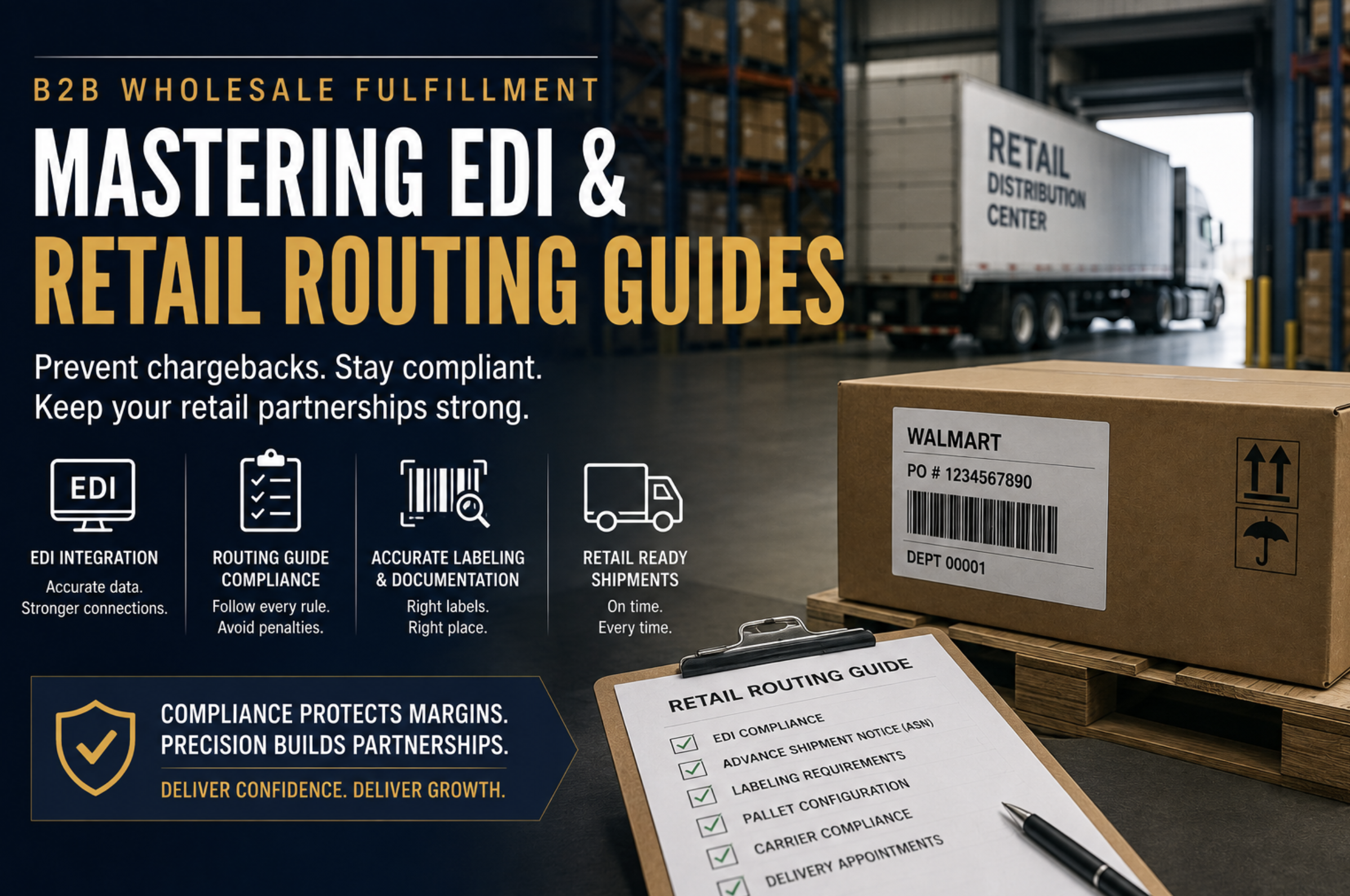
Landing a purchase order from a major retailer feels like a milestone.
Receiving a chargeback on that same order a few weeks later feels like a mystery.
The products were manufactured correctly.
The shipment left on time.
The carrier delivered it.
So why did your invoice suddenly shrink?
For many brands entering wholesale distribution, the answer isn’t product quality or demand—it’s compliance.
Large retailers operate with highly standardized logistics requirements. If suppliers don’t follow those requirements precisely, retailers may issue chargebacks for problems ranging from incorrect labeling to missed delivery appointments or improper pallet configuration.
That’s why successful wholesale brands don’t think of fulfillment as simply shipping products.
They think of it as executing a process with very little room for error.
If your business is expanding into retail distribution, understanding B2B wholesale fulfillment and retail routing guide compliance can protect both your margins and your retailer relationships.
Selling to Retailers Is Different From Selling to Consumers
Shipping a direct-to-consumer order is relatively straightforward.
A customer places an order.
You pick the product.
Pack it.
Print a shipping label.
The carrier delivers it.
Wholesale fulfillment is different.
Instead of sending one package to one customer, you may be shipping pallets, cartons, or mixed SKU orders to retailer distribution centers that have detailed operational requirements.
Those requirements often include:
- Purchase order accuracy
- Advance shipment notifications (ASNs)
- Electronic Data Interchange (EDI)
- Carton labels
- Pallet labels
- Barcode standards
- Appointment scheduling
- Packaging specifications
- Carrier selection
- Delivery windows
Missing one requirement can trigger delays—or chargebacks.
What Is B2B Wholesale Fulfillment?
B2B wholesale fulfillment is the process of receiving, storing, preparing, and shipping inventory to business customers such as retailers, distributors, and other commercial buyers.
Unlike consumer fulfillment, wholesale fulfillment often involves:
- Larger order quantities
- Palletized shipments
- Strict documentation
- Retail-specific compliance requirements
- Scheduled deliveries
- Vendor performance expectations
The operational complexity is significantly higher because retailers rely on standardized inbound processes to keep their distribution centers running efficiently.
Why Retail Routing Guides Matter
Every major retailer has its own routing guide.
A routing guide is essentially an operational handbook explaining how suppliers must prepare and ship inventory.
It may specify:
- Approved carriers
- Label placement
- Packaging standards
- Pallet dimensions
- Carton configuration
- Delivery scheduling
- Documentation requirements
- ASN timing
- Shipping methods
Retailers publish these requirements because consistent inbound shipments reduce receiving errors and improve warehouse efficiency.
Ignoring a routing guide isn’t simply breaking a recommendation.
It may violate the retailer’s vendor requirements.
The Real Cost of Chargebacks
Most businesses think of chargebacks as isolated deductions.
In reality, they can create a chain reaction.
One compliance mistake might lead to:
- Reduced invoice payments
- Additional administrative work
- Payment disputes
- Delayed receiving
- Inventory availability issues
- Lower vendor performance scores
- Increased operational costs
More importantly, repeated compliance failures can affect your relationship with the retailer.
Retail partnerships are built on reliability.
Operational consistency matters just as much as product quality.
EDI: The System Behind Modern Retail Logistics
One of the biggest differences between wholesale fulfillment and direct-to-consumer shipping is the use of Electronic Data Interchange (EDI).
EDI allows businesses to exchange standardized business documents electronically rather than manually.
Depending on the retailer, EDI transactions may include:
- Purchase orders
- Order acknowledgments
- Advance Shipment Notices (ASNs)
- Invoices
- Inventory updates
Accurate EDI communication helps retailers prepare for incoming shipments before trucks arrive.
When information is incomplete or inaccurate, receiving delays can occur.
That’s why EDI isn’t simply an IT project.
It’s an important part of fulfillment operations.
Compliance Starts Before Products Reach the Warehouse
Many fulfillment problems begin long before a shipment leaves the dock.
Suppliers send incorrect carton quantities.
Products arrive with inconsistent labeling.
Packaging varies between production runs.
SKUs are mixed.
These issues become more difficult—and more expensive—to correct once wholesale orders are already scheduled.
Strong wholesale operations build quality checks into receiving, inventory management, and outbound preparation rather than relying on final inspections alone.
A Retailer’s Distribution Center Runs on Precision
Imagine a distribution center receiving hundreds of trucks every day.
Every shipment is expected to arrive:
- On schedule
- Properly labeled
- Correctly documented
- Properly palletized
- Ready for efficient receiving
One shipment that doesn’t follow those requirements slows the receiving process.
Routing guides exist because retailers need consistency across thousands of suppliers.
Understanding that perspective helps suppliers appreciate why compliance matters.
Common Wholesale Fulfillment Mistakes
Many chargebacks originate from avoidable operational errors, including:
- Incorrect pallet configuration
- Missing carton labels
- Barcode errors
- Inaccurate ASNs
- Late shipments
- Incorrect carrier usage
- Mixed SKU pallets
- Documentation discrepancies
- Packaging that doesn’t meet retailer specifications
The good news?
These issues are often preventable with standardized processes and experienced fulfillment operations.
Why Growing Brands Outsource Wholesale Fulfillment
As wholesale programs expand, internal logistics teams often become responsible for more than shipping.
They’re managing:
- Retail compliance
- Multiple routing guides
- EDI transactions
- Appointment scheduling
- Carrier coordination
- Documentation
- Inventory visibility
- Retail-specific packaging
For many growing brands, partnering with an experienced B2B fulfillment provider allows internal teams to focus on product development, sales, and customer growth rather than navigating increasingly complex retailer requirements.
Choosing a Wholesale Fulfillment Partner
Not every fulfillment provider specializes in retail distribution.
If wholesale is becoming an important part of your business, ask questions such as:
- Do you support EDI workflows?
- How do you manage retailer routing guides?
- Can you prepare retailer-specific labeling?
- How are compliance updates managed?
- What quality-control procedures exist before shipments leave the warehouse?
- How do you handle retailer-specific packaging requirements?
- Can you support both wholesale and direct-to-consumer fulfillment?
The answers will tell you whether the provider understands retail logistics—or simply ships boxes.
Where ShipLogix Fits
Wholesale fulfillment requires more than warehouse space.
It requires operational discipline.
ShipLogix supports growing brands with B2B wholesale fulfillment services designed to help businesses navigate retailer requirements, prepare compliant shipments, and maintain efficient distribution workflows.
From inventory management and order processing to retailer-specific preparation and shipping optimization, the objective is simple:
Help brands move products into retailer distribution networks with greater accuracy and fewer costly compliance issues.
The Bottom Line
Winning retail business is difficult.
Keeping it often depends on execution.
Retailers expect suppliers to deliver products accurately, consistently, and in accordance with established routing guides.
The brands that succeed aren’t necessarily the ones with the largest warehouses.
They’re the ones with repeatable fulfillment processes that minimize errors before shipments ever leave the dock.
If your business is expanding into wholesale distribution—or you’re looking to improve retailer compliance—ShipLogix can help streamline your fulfillment operation, reduce unnecessary complexity, and build a process designed for long-term retail success.
Request a free fulfillment consultation to learn how ShipLogix can help support your B2B wholesale fulfillment strategy while reducing the operational risks that lead to costly retailer chargebacks.
0 Comments