
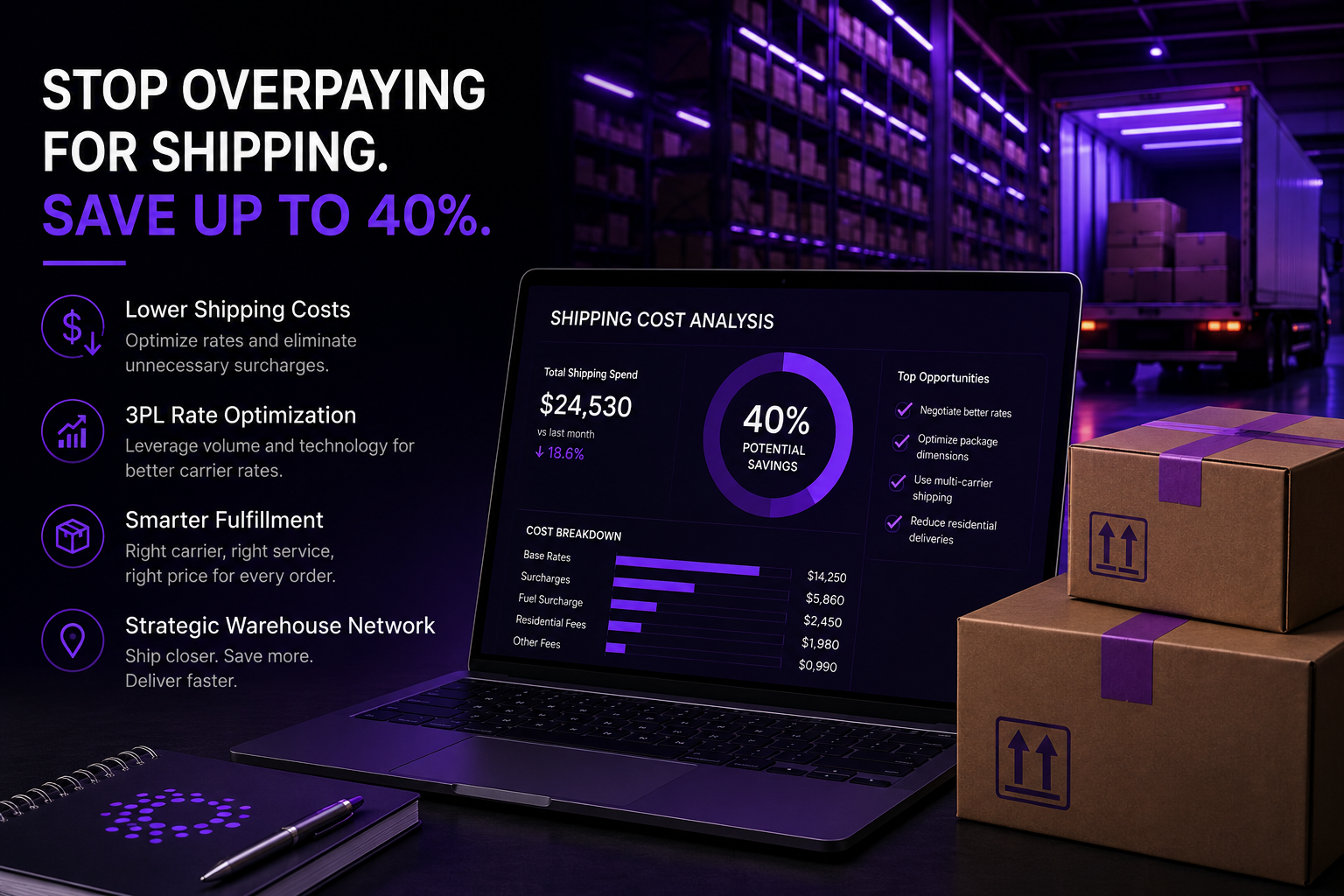
Why Growing E-Commerce Brands Are Overpaying by Up to 40% on Shipping—and How to Stop
Your e-commerce brand can double its order volume and still become less profitable.
The reason is hiding in plain sight.
Shipping.
A brand doing 1,000 orders per month may obsess over customer acquisition cost, conversion rate, average order value, and product margins. Then it grows to 5,000 or 10,000 monthly orders and assumes its shipping economics will automatically improve with scale.
Sometimes the opposite happens.
More orders simply multiply an inefficient shipping strategy.
A $2 unnecessary shipping expense doesn’t look catastrophic on a single order.
Across 10,000 monthly shipments?
That’s $20,000 every month—or $240,000 per year.
And the expensive part isn’t always the carrier’s advertised rate.
Growing e-commerce brands can lose margin through:
- Poor carrier selection
- Expensive shipping zones
- Dimensional-weight charges
- Surcharges
- Oversized packaging
- Underutilized regional carriers
- Weak negotiated rates
- Single-carrier dependency
- Inefficient fulfillment locations
- Failure to rate-shop every shipment
That’s why reducing e-commerce shipping costs requires more than asking UPS or FedEx for another discount.
You have to change the economics behind the shipment.
And that starts by understanding what you’re actually paying for.
The Retail Shipping Trap: Growth Doesn’t Automatically Give You the Best Rates
Here’s one of the biggest misconceptions in e-commerce logistics:
More shipping volume automatically means better shipping rates.
Not necessarily.
Volume certainly creates negotiating leverage. But an individual e-commerce company is still negotiating primarily on the strength of its own shipping profile.
That includes factors such as:
- Monthly parcel volume
- Package weights
- Package dimensions
- Destination ZIP codes
- Shipping zones
- Residential deliveries
- Service levels
- Carrier mix
- Pickup density
This creates what we call the retail shipping trap.
Your company may be large enough that shipping has become one of your biggest operating expenses—but not large enough individually to command the economics available to enormous shipping networks.
You end up stuck in the middle.
You’re shipping too much to ignore logistics optimization, but potentially not enough to maximize your leverage on your own.
That’s where 3PL rate optimization and volume aggregation can change the equation.
What Is 3PL Rate Optimization?
3PL rate optimization is the process of using aggregated shipping volume, multiple carrier relationships, shipment-level rate shopping, packaging optimization, and routing strategies to reduce the total cost of shipping orders.
Instead of treating shipping as:
Order → Preferred Carrier → Label
an optimized operation treats it more like:
Order → Analyze shipment → Compare eligible services → Select the best cost/service combination → Ship
That distinction becomes extremely valuable at scale.
If you’re shipping 10,000 packages every month, you don’t necessarily need one carrier to become 5% cheaper.
You need 10,000 individual shipping decisions to become smarter.
Why E-Commerce Brands Overpay for Shipping
1. You’re Negotiating With Your Volume Instead of a Larger Network’s Volume
Imagine Brand A ships 3,000 packages per month.
Brand B ships 5,000.
Brand C ships 10,000.
Individually, each negotiates according to its own profile.
A logistics network capable of aggregating shipping demand can potentially negotiate from a dramatically larger volume base.
This is one of the structural advantages available through certain 3PL and shipping networks.
What is volume aggregation?
Volume aggregation combines shipping demand across multiple businesses to create greater purchasing power with parcel carriers.
Think about it like wholesale purchasing.
A small retailer buying 500 units usually doesn’t receive the same economics as a distributor purchasing 500,000 units.
Transportation can work similarly.
The carrier isn’t only selling transportation.
It’s selling capacity.
Organizations capable of bringing carriers substantial, predictable volume can potentially negotiate economics that would be difficult for an individual growing brand to reproduce independently.
That’s why your shipping volume may be valuable without necessarily being large enough on its own to unlock the best available pricing structure.
2. You’re Using the Same Carrier for Too Many Shipments
UPS might be excellent for one shipment.
FedEx might win another.
USPS might make more sense for another.
A regional carrier may be the strongest option somewhere else.
There is rarely one carrier that is cheapest for every possible combination of:
origin + destination + weight + dimensions + service level.
Yet many brands develop a default:
“We ship UPS.”
That’s operationally convenient.
Financially, it can be expensive.
The better approach: shipment-level rate shopping
Multi-carrier rate shopping compares eligible carrier services before the label is generated.
For example:
| Shipment | Carrier A | Carrier B | Carrier C | Best Option |
| California → Arizona | $8.70 | $9.40 | $7.95 | Carrier C |
| California → Texas | $12.10 | $10.80 | $11.60 | Carrier B |
| California → New York | $16.20 | $14.90 | $15.40 | Carrier B |
Illustrative example only; actual rates vary by account and shipment.
Saving $0.75 here and $1.30 there doesn’t feel transformational.
Until software repeats that decision thousands of times.
If optimization saves an average of just $1 per shipment across 10,000 monthly orders, that’s:
$10,000 per month.
$120,000 per year.
That’s why serious shipping optimization happens at the shipment level—not just during an annual carrier negotiation.
3. You’re Paying to Ship Packages Across Zones They May Not Need to Cross
Distance matters enormously in parcel economics.
Carriers divide delivery geography into shipping zones. Generally, the farther a package travels from its origin, the more expensive transportation becomes.
So imagine you’re fulfilling every order from California.
A customer in Nevada may be relatively inexpensive to serve.
A customer in New York is another story.
You’re moving that parcel across the country through multiple parts of a carrier’s network.
But what if individual parcels didn’t have to make that entire journey independently?
That’s where zone skipping becomes interesting.
What Is Zone Skipping?
Zone skipping consolidates multiple packages traveling toward the same geographic region, transports them together closer to their destinations, and injects them into a parcel carrier’s network farther downstream.
Instead of this:
Warehouse → Carrier Network → Zone 2 → 3 → 4 → 5 → 6 → 7 → Customer
the model can look more like:
Warehouse → Consolidated Transportation → Destination Region → Local Parcel Network → Customer
The parcel effectively “skips” part of the traditional zone journey.
Honeywell describes the strategy similarly: orders can be pre-sorted and moved closer to their destinations before carrier handoff, reducing the number of carrier handling stages. Shopify also describes zone skipping as consolidating shipments headed toward the same region and injecting them closer to final delivery. citeturn0search1turn0search2
Why does zone skipping reduce shipping costs?
Because you’re replacing part of an expensive individual parcel movement with more economical consolidated transportation.
The concept isn’t appropriate for every business.
You need sufficient volume, predictable destination density, and economics that justify consolidation.
But when those conditions exist, zone skipping can become one of the most powerful tools available to high-volume e-commerce operations.
4. Your Box May Be Costing More Than the Product Inside It
Here’s a mistake that’s incredibly easy to overlook.
You weigh your package.
It weighs 4 pounds.
So you assume you’re paying to ship 4 pounds.
You may not be.
Major parcel carriers use dimensional weight, commonly called DIM weight, to account for the amount of space a package consumes.
UPS explains dimensional weight as the space a package occupies compared with its actual weight, and notes that it may apply to domestic and international package services. FedEx similarly states that shipments can be charged according to actual or dimensional weight, whichever is greater. citeturn1search0turn1search10
That means a lightweight product packed inside an unnecessarily large box can effectively become a much “heavier” shipment for billing purposes.
Example
Imagine a lightweight product ships in a:
18 × 14 × 10-inch box
Using a DIM divisor of 139 for illustration:
18 × 14 × 10 = 2,520 cubic inches
2,520 ÷ 139 = 18.13 pounds
Rounded according to applicable carrier rules, a product that physically weighs only a few pounds could potentially be rated at a dramatically higher billable weight.
UPS currently states that its dimensional divisor varies by rate type and lists 139 for Daily Rates and 166 for Retail Rates. citeturn1search0
That’s why packaging optimization isn’t just about saving cardboard.
You’re optimizing transportation cost.
5. You’re Looking at Base Rates Instead of Total Landed Shipping Cost
“We negotiated a 40% discount.”
Forty percent off what?
This is where carrier agreements can become deceptively complicated.
A seemingly attractive transportation rate doesn’t necessarily tell you what the shipment will ultimately cost.
Depending on the carrier, service and shipment, additional costs can include things such as:
- Residential surcharges
- Delivery-area surcharges
- Additional handling
- Large-package fees
- Dimensional-weight adjustments
- Address corrections
- Peak or demand-related charges
- Other accessorial fees
UPS specifically identifies dimensional weight, additional handling, residential surcharges, incorrect weight and large-package surcharges among common sources of shipping charge corrections or added cost. citeturn1search2
That’s why sophisticated shipping analysis shouldn’t ask:
“What’s my discount?”
It should ask:
“What is my true transportation cost per delivered order?”
Those are very different questions.
6. Your Fulfillment Location May Be Creating the Problem
You can negotiate aggressively and optimize packaging perfectly—and still have an expensive network.
Why?
Because inventory is sitting too far away from customers.
Imagine 70% of your customers live east of Texas, but every order ships from California.
You’re structurally creating long-distance shipments.
At sufficient scale, it can make sense to compare:
One centralized warehouse
versus
Strategically distributed inventory
versus
Zone-skipped consolidated transportation
There isn’t one universally correct answer.
Multiple warehouses can reduce parcel distance but introduce other costs:
- Additional inventory
- Inventory balancing
- Warehousing expenses
- Receiving costs
- Operational complexity
- Technology requirements
Zone skipping can reduce certain long-distance parcel costs without requiring every brand to immediately duplicate inventory across several warehouses.
The right answer depends on your actual order geography.
Which leads to perhaps the most important principle in this article.
Stop Optimizing Shipping Using Averages
Suppose your average shipping cost is:
$10.72 per order.
Is that good?
You don’t know.
An average hides the information needed to improve it.
Instead, break transportation spend down by:
Destination
Where are customers located?
Zone
Which zones consume the most shipping dollars?
Weight
Which weight bands become disproportionately expensive?
Dimensions
Which SKUs trigger DIM-weight pricing?
Carrier
Which carrier performs best for each shipment profile?
Service
Are you paying for faster transportation than customers actually require?
Surcharge
How much of your transportation spend isn’t base transportation at all?
SKU
Which products have fundamentally bad shipping economics?
Once you can answer those questions, shipping stops being an unavoidable expense.
It becomes something you can engineer.
The Shipping Cost Audit Every Growing E-Commerce Brand Should Run
If you’re shipping roughly 1,000+ orders per month, start here.
Take the last 30–90 days of shipment data and identify:
- Total parcel spend
- Number of shipments
- Average cost per shipment
- Cost by carrier
- Cost by service
- Cost by zone
- Cost by package weight
- Cost by package dimensions
- Residential and delivery-area surcharges
- Other accessorial charges
- Average delivery time
- Percentage of shipments going to Zones 6–8
- Top destination states and ZIP-code regions
- Your most expensive SKUs to ship
- Your most frequently used carton sizes
Then ask a more valuable question:
If every shipment had been optimized across multiple carriers and rate structures, what would we have paid instead?
That number is your opportunity.
The $1 Shipping Rule
Here’s a simple way to understand why shipping deserves executive-level attention.
For every:
1,000 shipments/month → $1 saved = $12,000/year
5,000 shipments/month → $1 saved = $60,000/year
10,000 shipments/month → $1 saved = $120,000/year
25,000 shipments/month → $1 saved = $300,000/year
50,000 shipments/month → $1 saved = $600,000/year
This is simple arithmetic, not a savings guarantee.
But it illustrates why tiny shipping improvements become enormous at scale.
Your next major margin improvement may not come from acquiring cheaper traffic.
It may already be sitting inside your shipping data.
Where a 3PL Can Change the Economics
A traditional view of a 3PL is simple:
“They store my products and ship my orders.”
That’s increasingly incomplete.
The more valuable question is:
What logistics infrastructure, technology, carrier access, and transportation economics does the 3PL give me that I couldn’t efficiently build myself?
A sophisticated 3PL relationship can potentially combine:
Fulfillment + technology + transportation optimization + purchasing leverage.
That can include:
- Aggregated carrier volume
- Multi-carrier rate shopping
- Enterprise shipping rates
- Regional carrier access
- Zone-skipping opportunities
- Optimized routing
- Real-time inventory visibility
- Automated order processing
- B2B and DTC fulfillment
- Better shipping analytics
That’s the philosophy behind ShipLogix.
ShipLogix combines fulfillment infrastructure with shipping optimization rather than treating transportation as an afterthought.
Its shipping platform is designed to compare options across a multi-carrier network, while its fulfillment and warehouse technology provides visibility across inventory, orders, transportation, tracking and billing.
The objective isn’t simply to print labels faster.
It’s to make the logistics network smarter.
“But We Already Have a 3PL.”
Good.
Switching warehouses isn’t automatically the answer.
Before considering a disruptive operational change, determine whether your current transportation costs are actually competitive.
Ask:
- What am I paying by zone?
- What am I paying by weight?
- Which surcharges am I absorbing?
- Is every shipment being rate-shopped?
- What alternatives exist for my highest-cost lanes?
- Are my current carrier discounts actually competitive?
- Could aggregated volume improve my economics?
- Does my current network support zone skipping?
- Could I reduce costs without changing my fulfillment operation?
ShipLogix specifically states that its enterprise-rate offering can integrate with an existing WMS, shipping software, or e-commerce platform without requiring the business to replace its current fulfillment workflow. citeturn0search6
That means the first step doesn’t have to be:
“Move my entire warehouse.”
It can simply be:
“Show me what I’m overpaying.”
That’s a much easier decision.
How Much Could Your Brand Actually Save?
There isn’t an honest universal percentage.
A brand shipping lightweight local parcels has a very different opportunity than a company shipping bulky products nationwide.
Potential savings depend on:
- Current negotiated rates
- Monthly volume
- Package dimensions
- Package weights
- Destination zones
- Carrier mix
- Service levels
- Fulfillment locations
- Customer geography
- Surcharges
- Existing technology
- Eligibility for consolidation or zone skipping
Some logistics providers publicly advertise savings approaching 30–40% on qualifying zone-skipped parcel volume, but those results should not be assumed for every shipper. citeturn0search4
The only useful number is the one calculated using your shipping data.
And that’s exactly why a shipping-cost analysis should come before changing carriers, software, or fulfillment providers.
The Fastest Way to Find Out Whether You’re Overpaying
If your brand is shipping hundreds or thousands of orders every month, don’t start by renegotiating blindly.
Benchmark your current operation first.
ShipLogix’s shipping analysis looks at variables including your shipping volume, origin, package characteristics, and logistics profile to determine what alternative rate structures may be available.
You can use the ShipLogix Shipping Savings Calculator to start that analysis.
You don’t have to assume you’re overpaying.
Find out.
If your current rates are competitive, you’ll know.
If they’re not, you’ll see where the opportunity exists before making a major operational decision.
The Bottom Line
Most growing e-commerce brands don’t have a “shipping problem.”
They have a shipping optimization problem.
The difference matters.
Shipping becomes expensive when brands continue operating with a logistics strategy designed for a smaller company:
One warehouse.
One preferred carrier.
One negotiated rate card.
Oversized packaging.
Limited visibility.
No shipment-level optimization.
No consolidated transportation strategy.
No meaningful benchmark.
At 500 shipments per month, some inefficiencies are tolerable.
At 5,000, they’re expensive.
At 50,000, they can become enormous.
The brands that scale profitably don’t simply ship more packages.
They make every package economically smarter.
Find Out What You’re Actually Overpaying
You already have the data needed to determine whether your shipping strategy is costing you margin.
ShipLogix can analyze your current shipping profile and identify opportunities across carrier rates, routing, volume leverage and fulfillment strategy.
No guessing.
No generic “save up to X%” promise.
Just a comparison based on how your company actually ships.
Submit your shipping profile and see what your current rates are really costing you.
→ Run Your Free Shipping Cost Analysis
Frequently Asked Questions
How can an e-commerce company reduce shipping costs?
E-commerce companies can reduce shipping costs by optimizing packaging, comparing multiple carriers, negotiating better rates, reducing shipping zones, using regional carriers where appropriate, optimizing fulfillment locations, minimizing surcharges and using 3PL volume aggregation. The best strategy depends on shipment weight, dimensions, destination distribution and monthly volume.
How do 3PLs get cheaper shipping rates?
Some 3PLs aggregate shipping volume across multiple customers, creating a larger overall shipping profile that may qualify for more favorable carrier economics. Advanced 3PLs may also optimize shipments across multiple carriers rather than routing every package through one provider.
What is 3PL rate optimization?
3PL rate optimization is the process of reducing transportation costs through carrier-rate negotiation, aggregated volume, multi-carrier rate shopping, packaging optimization, zone management, routing and other transportation strategies.
What is zone skipping in e-commerce shipping?
Zone skipping consolidates packages traveling toward the same geographic region and transports them in bulk closer to their destinations before injecting individual parcels into a local or regional carrier network. This can reduce the number of parcel zones involved in final delivery and, for qualifying shipping profiles, lower transportation costs.
At what shipping volume should I consider a 3PL?
There is no universal minimum. A brand should evaluate a 3PL when fulfillment or transportation complexity begins consuming internal resources or when outside infrastructure, technology, carrier access or shipping economics could outperform the existing operation. Brands shipping 1,000+ monthly orders are especially worth benchmarking because even small per-package improvements can become financially meaningful.


0 Comments