
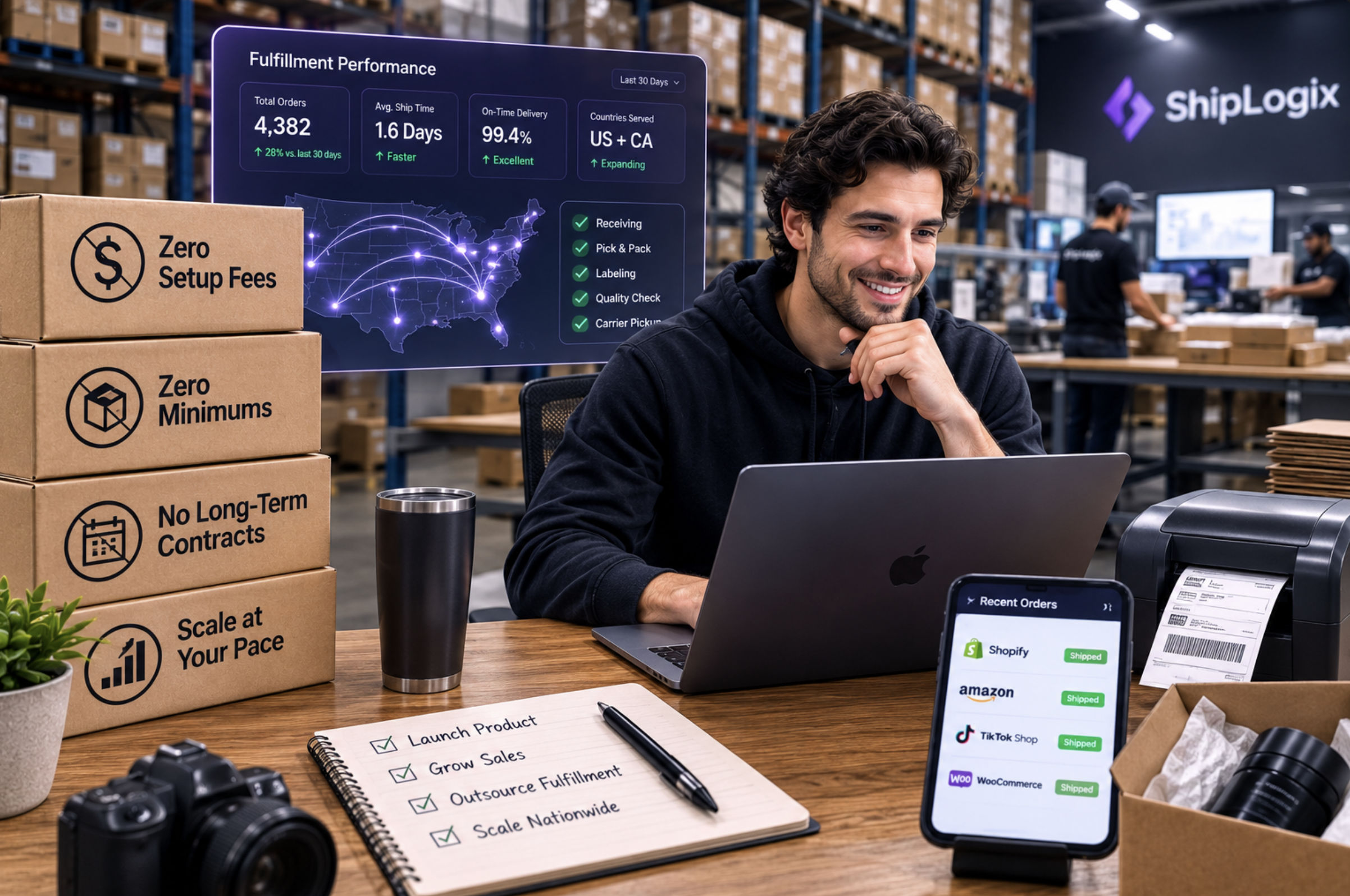
Picture this.
You’ve finally found a fulfillment provider that promises faster shipping, better rates, and room to grow.
Then the proposal arrives.
- $2,500 onboarding fee.
- Six-month contract.
- Monthly order minimums.
- Storage commitments.
- Additional implementation charges.
Before your first order ships, you’ve already made a significant financial commitment.
For many growing e-commerce brands, that’s enough to walk away.
Not because outsourcing fulfillment isn’t the right move—but because the risk feels too high.
Modern fulfillment shouldn’t require a leap of faith. Increasingly, businesses are looking for a 3PL with no minimumsand pricing models that let them grow without being locked into commitments they may not be ready for.
The best partnerships aren’t built on penalties for being small.
They’re built on helping businesses become bigger.
Why Traditional 3PL Pricing Doesn’t Fit Every Business
Many third-party logistics providers were designed around established brands shipping thousands of orders every month.
That business model often works well for high-volume customers because predictable order flow helps warehouses plan labor, storage, and transportation.
But today’s e-commerce landscape looks different.
Brands don’t always grow in a straight line.
Sales fluctuate.
New products launch.
Advertising campaigns succeed—or fail.
Seasonality affects demand.
A startup might ship 200 orders one month and 2,000 the next.
Rigid pricing models don’t always accommodate that reality.
The Problem With Order Minimums
Order minimums exist for a reason.
Warehouses invest in labor, technology, space, and operational resources regardless of how many orders a customer ships.
Some providers offset that investment by requiring a minimum monthly order volume or charging a minimum monthly fee.
For established brands, this may not be an issue.
For growing businesses, it can become another fixed expense during slower months.
Instead of fulfillment scaling with the business, the business must scale to justify the fulfillment agreement.
That can create unnecessary financial pressure.
What “No Minimums” Actually Means
A 3PL with no minimums doesn’t necessarily mean there are no costs.
It generally means you’re not required to meet a predetermined shipping volume to maintain the partnership.
Instead, fulfillment costs are more closely tied to actual activity.
If your order volume grows, fulfillment activity grows.
If sales temporarily slow, you’re not paying penalties simply because demand changed.
That flexibility can be especially valuable for businesses that experience:
- Seasonal demand
- Product launches
- Crowdfunding campaigns
- Rapid growth
- Inventory transitions
- Promotional spikes
Every provider structures pricing differently, so it’s important to understand exactly how fees are calculated before signing an agreement.
Why Setup Fees Can Delay Growth
Moving fulfillment providers already requires planning.
Inventory transfers.
System integrations.
Operational testing.
Carrier coordination.
Adding a large upfront implementation fee can make businesses postpone improvements they actually need.
Some brands continue operating inefficient fulfillment processes simply because switching appears too expensive.
Ironically, the delay often costs more than the setup fee would have.
The longer operational inefficiencies remain, the more they affect customer experience, labor costs, and shipping performance.
Low Risk Doesn’t Mean Low Quality
One misconception is that lower commitment means lower service.
That’s not necessarily true.
A fulfillment provider that offers flexible onboarding is often making a different statement:
“We’re confident enough in our service that we don’t need to rely on long-term commitments to keep customers.”
Strong partnerships are usually earned through consistent performance rather than contractual obligations.
Businesses stay because the relationship creates value—not because it’s difficult to leave.
Flexibility Supports Smarter Growth
Early-stage and growing brands rarely have perfect forecasts.
Marketing campaigns can outperform expectations.
Seasonal demand can shift.
New retail opportunities can emerge unexpectedly.
Flexible fulfillment allows businesses to adapt without renegotiating contracts every time order volume changes.
That flexibility can make it easier to:
- Launch new products
- Test new markets
- Expand sales channels
- Manage seasonal demand
- Scale operations with confidence
Instead of worrying about meeting fulfillment requirements, businesses can focus on growing revenue.
Questions to Ask Before Choosing a Fulfillment Partner
Price matters.
But flexibility matters too.
Before selecting a fulfillment provider, consider asking:
- Are there setup or onboarding fees?
- Are monthly order minimums required?
- Is there a long-term contract?
- How does pricing change as my business grows?
- What happens if my order volume temporarily decreases?
- Are there penalties for low-volume months?
- How quickly can fulfillment capacity scale?
The answers often reveal whether a provider is designed for long-term partnerships—or simply for predictable volume.
A Modern 3PL Should Grow With Your Business
The relationship between a brand and its fulfillment provider shouldn’t feel one-sided.
Your logistics partner should be able to support your business whether you’re shipping hundreds of orders or tens of thousands.
That doesn’t mean every provider is the right fit for every business.
Some specialize in enterprise distribution.
Others focus on high-volume retail.
Others are designed to help emerging direct-to-consumer brands scale without unnecessary operational barriers.
Finding the right match is often more important than finding the cheapest quote.
Where ShipLogix Fits
ShipLogix was built to help growing e-commerce brands scale fulfillment without unnecessary complexity.
Rather than creating additional barriers through rigid onboarding requirements, ShipLogix focuses on flexible fulfillment solutions, enterprise shipping rates, modern warehouse technology, and scalable logistics services that support businesses as they grow.
Whether you’re expanding beyond self-fulfillment or looking for a more adaptable logistics partner, the goal is simple:
Provide fulfillment that grows with your business—not one that holds it back.
The Bottom Line
Growth is unpredictable.
Your fulfillment strategy should be prepared for that.
The best logistics partnerships aren’t built on minimum order requirements or expensive onboarding fees.
They’re built on transparency, flexibility, and operational performance.
If you’re searching for a 3PL with no minimums or a low-risk e-commerce fulfillment partner that allows your business to scale on its own timeline, it may be time to rethink what a modern fulfillment partnership should look like.
Ready to explore a more flexible approach to fulfillment? Contact ShipLogix for a free shipping and fulfillment consultation and discover how the right logistics partner can help your business grow with confidence.



0 Comments