
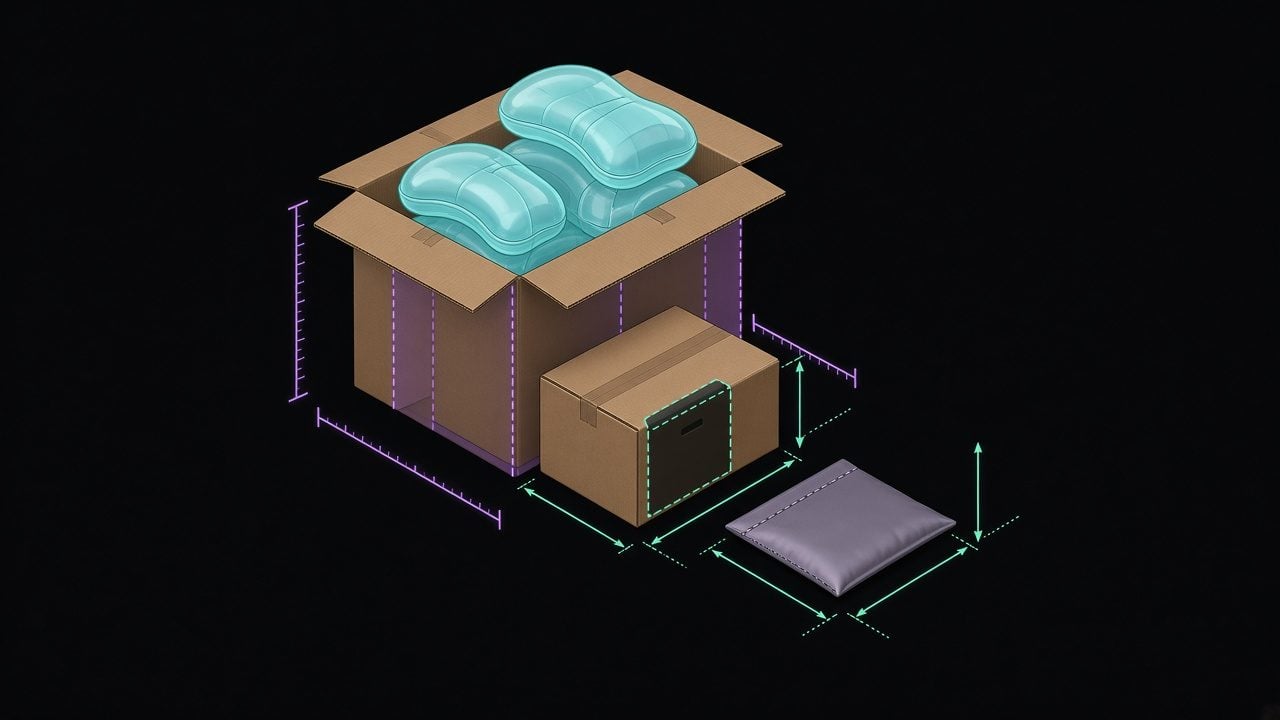
Answer first: Most parcel carriers bill the greater of a package’s actual scale weight and its dimensional (DIM) weight. If your box is bigger than the product needs, you can pay as if the carton were heavier than it is—even when the product itself is light. Cartonization (choosing the smallest safe outer pack) is one of the highest-leverage packing decisions an ecommerce operator can make before rate shopping.
This guide is for brand operators who pack DTC orders in-house or oversee a 3PL. It explains how DIM weight is calculated (using published carrier methods), walks a worked example, and ends with a practical checklist you can run this week. No invented savings percentages—just an operator workflow you can verify against your own labels.
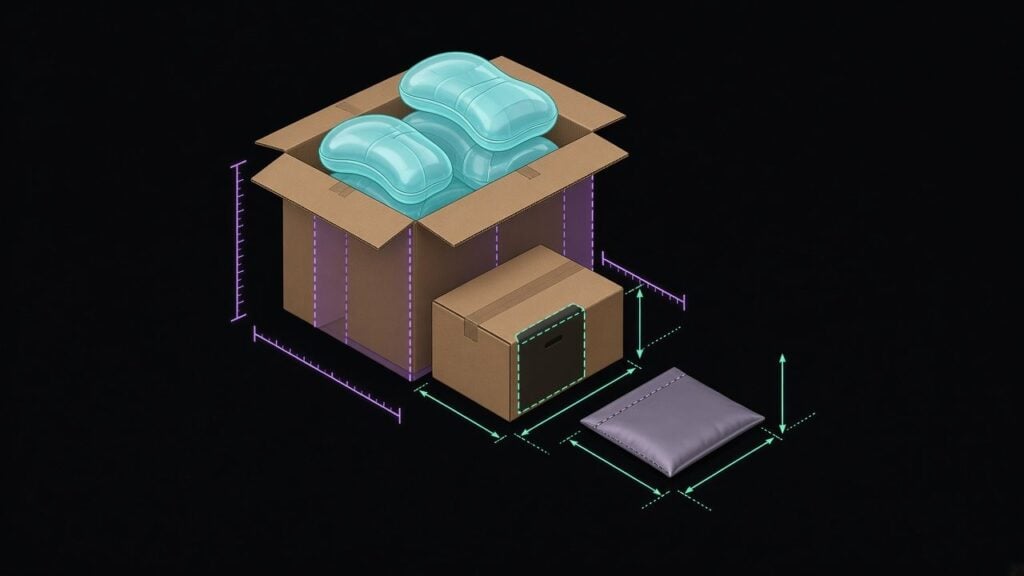
What dimensional weight actually bills
Dimensional weight reflects how much space a package occupies relative to its scale weight. Carriers document the same core idea: measure length × width × height, divide by a divisor (also called a DIM factor), then compare that result to actual weight. The greater value becomes the billable weight used for rating.
Public carrier documentation currently used for U.S. parcel planning commonly cites a 139 divisor for many daily / standard account calculations (inches → pounds). UPS also documents a different divisor for some retail rate types (for example, 166 for domestic retail in its retail rate guide). FedEx’s dimensional-weight explainer likewise walks the L × W × H ÷ 139 method for the shipments it describes. Always confirm the divisor and rounding rules on your account and service—published guides change, and contract terms can differ.
Practical takeaway for operators: a light SKU in an oversized carton frequently “looks” cheap on a scale and expensive on an invoice. That gap is where cartonization pays for itself.
Worked example: same product, two boxes
Illustrative only—not a quote. Assume a soft-goods SKU that scales at 2 lb when packed. You are comparing two outer packs, using a 139 divisor and whole-inch dimensions (confirm rounding with your carrier).
| Pack option | Outer L × W × H (in) | Cubic inches | DIM wt (÷139) | Actual wt | Billable wt (greater) |
|---|---|---|---|---|---|
| Oversized shipper | 18 × 14 × 8 | 2,016 | ~14.5 → 15 lb | 2 lb | 15 lb |
| Right-sized shipper | 12 × 9 × 4 | 432 | ~3.1 → 4 lb | 2 lb | 4 lb |
Nothing about the product changed—only the outer cube. On many rate cards, moving from a 15 lb billable weight to a 4 lb billable weight is a larger swing than switching carriers after the fact. That is why packaging decisions belong before you compare UPS vs FedEx vs regional options in a rate shop.
Cartonization checklist for ecommerce operators
Run this on your top 20 SKUs by ship volume (or your top kits/bundles). Capture results in a simple sheet your warehouse or 3PL can follow.
- Measure the product, not the marketing box. Record product L/W/H and weight, then the minimum protective packaging you truly need (mailer, void fill, inserts).
- List every approved outer pack you already buy (mailers, poly bags, #2–#6 shippers, custom cartons). Include inner dimensions if your team packs to ID.
- Assign a primary pack per SKU that fits with acceptable protection—no “default to the big brown box.”
- Compute DIM weight for each primary pack with your live divisor (often 139 for daily-style ratings; verify). Flag SKUs where DIM ≫ actual.
- Stress-test fragile and high-return SKUs. Right-sizing never means under-protecting. If damage rates rise, the “savings” reverse through reships and CX cost.
- Codify pack rules in WMS / packing UI so pickers are not improvising at 4 p.m. Cutoff pressure is when oversized cartons proliferate.
- Re-audit after assortment changes (new kits, holiday gift sets, influencer bundles). Bundles are classic DIM traps.
When a poly mailer beats a box
Apparel, soft goods, and many non-fragile accessories often ship safer and denser in poly mailers or padded mailers than in corrugated. Lower cube frequently drops you out of DIM-dominant billing. Confirm carrier rules for your mailer type and any surcharge triggers (shape, packaging type, length + girth).
When protection still wins
Glass, liquids, ceramics, and dense electronics may need rigid cartons and intentional void fill. Cartonization here means the smallest carton that still protects, not the absolute smallest mailer. Track damage claims by pack type so you are optimizing margin, not just label cost.
Where cartonization meets rate shopping and fulfillment
Right-sized packs make multi-carrier rate shopping more honest: you are comparing services against a realistic billable weight, not an accidental cube. If you keep fulfillment in-house, pair packaging standards with access to competitive multi-carrier rates. If you outsource pick/pack, ask your 3PL how they assign cartons, whether pack rules are SKU-level, and how they report DIM-driven exceptions.
Useful ShipLogix pages while you operationalize this:
- Enterprise shipping rates — pooled multi-carrier rates for brands that keep fulfillment in-house
- Ecommerce fulfillment — DTC pick/pack workflows where carton rules live day to day
- Shipping savings calculator — a starting point before a deeper label review
- Warehouse management software — visibility for inventory and fulfillment execution
Want a shipping cost analysis on your real labels?
If DIM-heavy cartons or single-carrier habits are eating margin, talk through your last 30–90 days of labels with ShipLogix. Bring a sample of your top SKUs and current pack types—we will help you see whether packaging, rates, or fulfillment structure is the bigger lever.
Operator takeaways
- Billable weight is usually the greater of actual vs dimensional weight—oversized cartons create “phantom pounds.”
- Confirm your divisor and rounding from current carrier docs for your rate type (commonly 139 for many daily-style ratings).
- Codify SKU-level pack rules; do not leave carton choice to peak-hour improvisation.
- Protect product first, then minimize cube. Damage-driven reships erase label savings.
- Revisit kits, bundles, and seasonal sets—they are frequent DIM surprises.
Book a Call with ShipLogix when you are ready to review packaging and rates together.
Sources (verify current terms): FedEx, “What is dimensional weight?” (fedex.com); UPS Shipping Dimensions and Weight / Rate & Service Guides describing Daily (139) and Retail (166 domestic) divisors (ups.com). Divisors and rounding rules can change—confirm against your account.


0 Comments