
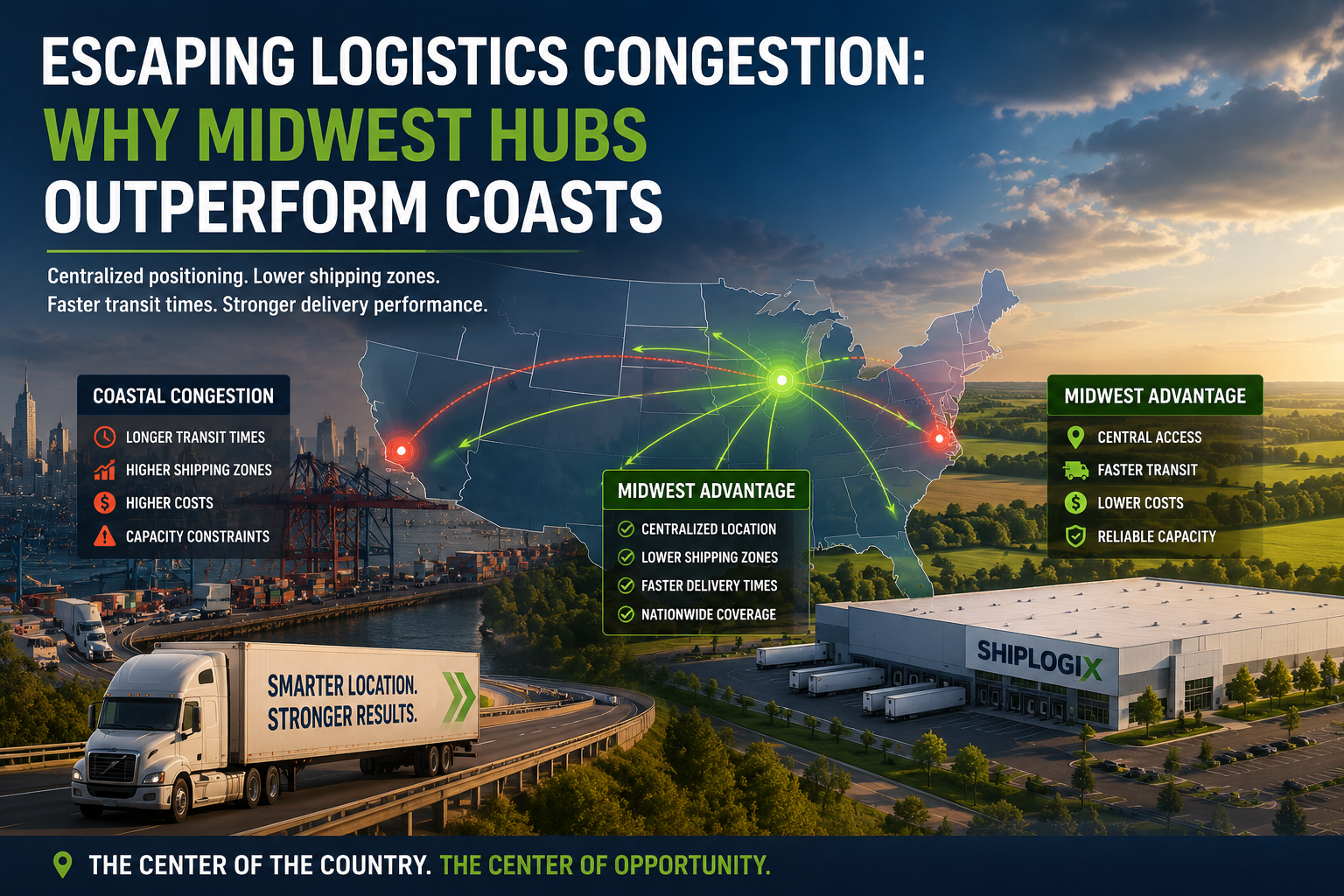
Walk into almost any strategy meeting at a growing e-commerce company, and you’ll hear the same conversation.
“We need better shipping rates.”
It’s a logical place to start. Carrier invoices are easy to measure, easy to compare, and easy to blame.
But shipping rates are often a symptom—not the problem.
A brand can negotiate aggressive discounts with UPS or FedEx and still spend more on shipping than necessary if every package begins its journey in the wrong location.
For companies serving customers across the United States, geography has become one of the most overlooked competitive advantages in logistics. The location of your fulfillment center affects delivery speed, shipping costs, inventory strategy, and your ability to scale efficiently. In many cases, moving inventory closer to the center of the country can have a greater impact than negotiating another percentage point off carrier rates.
That’s why more brands are looking beyond traditional coastal distribution and toward the Midwest.
Why Coastal Warehouses Aren’t Always the Best Choice
The largest ports in the United States are located along the East and West Coasts, so it’s natural for many businesses to establish their first warehouse nearby. Imported inventory arrives, products are stored, and orders begin shipping.
This model works well when most customers are located in the same region.
The challenge begins when a business grows nationally.
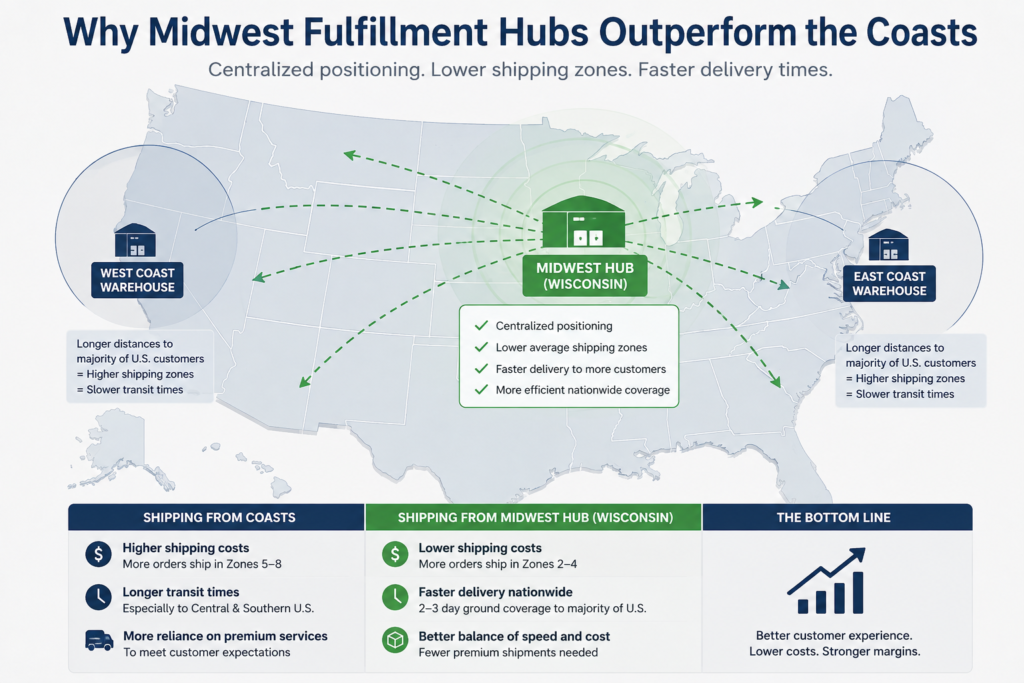
If every order ships from a single coastal warehouse, customers thousands of miles away require longer transportation routes, more shipping zones, and often higher parcel costs. Faster shipping becomes harder to achieve without paying for premium services.
In other words, your warehouse location starts working against you.
The Advantage of Being in the Middle
A centrally located fulfillment operation changes the equation.
Instead of consistently shipping across the entire country, inventory positioned in the Midwest can reach a larger percentage of U.S. customers within shorter transit distances.
This matters because parcel carriers generally base pricing on multiple factors, including package characteristics, service level, and shipping zones. While every shipment is different, reducing the average distance your packages travel can improve both delivery speed and transportation efficiency.
Think of it this way:
A fulfillment network shouldn’t be designed around where your business is headquartered.
It should be designed around where your customers live.
Why Wisconsin Is Becoming a Strategic Fulfillment Location
When businesses search for a Wisconsin fulfillment center, they’re often surprised to discover how strategically positioned the state is for nationwide distribution.
Wisconsin provides convenient access to major interstate highways and sits within one of the country’s most important freight corridors. Its proximity to Chicago’s transportation network gives businesses access to extensive parcel, trucking, and rail infrastructure without operating directly inside one of the nation’s busiest logistics markets.
For companies shipping throughout the United States, that central location creates several advantages:
- More balanced transit times nationwide
- Access to multiple parcel carrier networks
- Improved flexibility for national distribution
- Efficient connections to Midwest, Northeast, and Southern markets
- Potential opportunities to reduce average shipping zones
Rather than treating Wisconsin as simply another warehouse location, many businesses view it as a strategic distribution hub.
Faster Shipping Doesn’t Always Require More Warehouses
One common misconception is that improving delivery speed requires opening fulfillment centers across the country.
Sometimes it does.
Sometimes it doesn’t.
Before investing in multiple warehouses, businesses should ask a different question:
Would relocating one warehouse improve our network enough to delay the need for several more?
For many growing brands, a centrally positioned fulfillment center provides broader national coverage than a coastal facility without introducing the operational complexity of managing multiple inventory locations.
The answer depends on your customers, products, and shipping profile—but it’s a question worth evaluating.
How Zone Skipping Complements a Centralized Warehouse
Warehouse location is only one piece of an efficient logistics strategy.
Another is zone skipping.
Instead of moving every parcel individually across multiple shipping zones, qualifying shipments can be consolidated, transported closer to their destination region, and then entered into the parcel carrier’s network.
When combined with a centrally located fulfillment operation, zone skipping can further reduce unnecessary transportation movement for high-volume shipping programs.
Not every business ships enough volume to benefit from this strategy, but for brands that do, warehouse placement and zone skipping often work together—not independently.
The Bigger Picture: Logistics Is a Network, Not a Building
It’s easy to think of a warehouse as four walls and a loading dock.
In reality, it’s the starting point of every customer experience.
Every shipping label.
Every transit time.
Every carrier handoff.
Every delivery expectation.
The warehouse you choose influences all of them.
That means selecting a fulfillment center isn’t simply a real estate decision—it’s a network design decision.
Businesses that periodically reevaluate their fulfillment strategy often discover opportunities to improve delivery performance without dramatically changing the rest of their operation.
How ShipLogix Helps Brands Build Smarter Fulfillment Networks
At ShipLogix, fulfillment is designed around the entire logistics journey—not just storing inventory.
By combining strategically located fulfillment operations, multi-carrier shipping optimization, enterprise shipping rates, warehouse technology, and distribution strategies like zone skipping, ShipLogix helps growing brands build networks that are designed for both speed and scalability.
The goal isn’t simply to move products faster.
It’s to create a fulfillment strategy that reduces unnecessary transportation, improves operational efficiency, and supports long-term growth.
Is Your Warehouse Working for You—or Against You?
If your business serves customers across the United States, your biggest logistics opportunity may not be negotiating another carrier contract.
It may be rethinking where your inventory starts its journey.
A centrally located fulfillment network can improve delivery performance, simplify nationwide distribution, and create a more efficient shipping strategy as your business grows.
If you’re evaluating whether your current warehouse location is still the right fit, ShipLogix can help analyze your shipping profile, customer geography, and fulfillment network to identify opportunities for faster deliveries, lower transportation costs, and a more scalable logistics operation.


Hi, this is a comment.
To get started with moderating, editing, and deleting comments, please visit the Comments screen in the dashboard.
Commenter avatars come from Gravatar.