
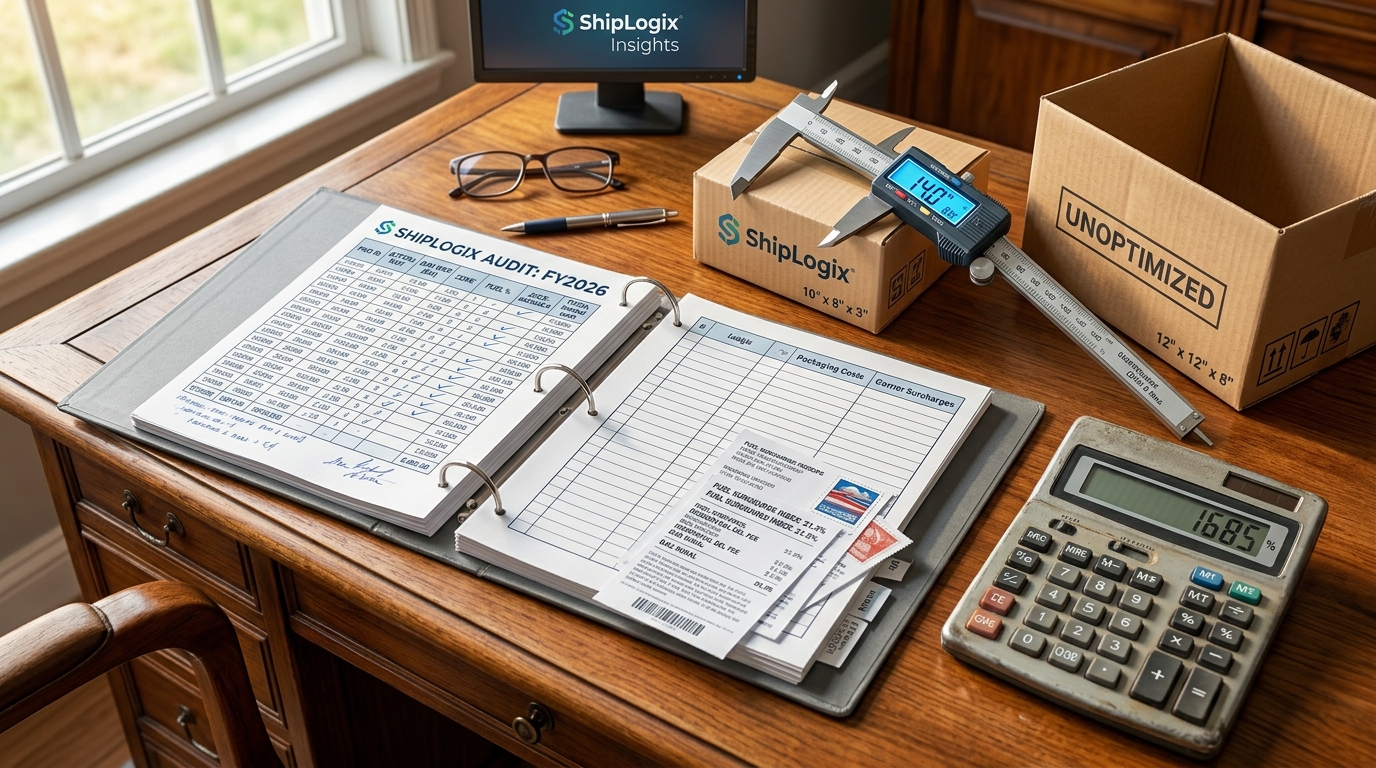
Shipping expenditure is rarely a single, transparent line item on a profit and loss statement. Instead, it is a complex accumulation of base transportation rates, dimensional weight adjustments, fuel surcharges, and variable carrier fees.
For growing e-commerce brands, shipping costs often represent the second-highest operating expense behind inventory procurement. Yet, an overwhelming majority of merchants pay significantly more than necessary due to unexamined billing structures and unoptimized packaging.
Calculating true landed shipping costs requires looking beyond retail rate tables to audit the precise variables carriers use to build final invoices.
The True Shipping Cost Formula
To determine the exact cost of shipping any order, logistics managers must evaluate four core variables:
- Dimensional Weight (DIM) vs. Actual Weight
- Zone-Based Distance Tariffs
- Variable Accessorial Surcharges
- Packaging and Operational Overhead
Total Shipping Cost=Base Rate(Billed Weight,Zone)+∑Accessorial Surcharges+Packaging
Step 1: Calculate Billed Weight (Dimensional Weight)
Major parcel carriers—including FedEx, UPS, and DHL—bill based on whichever is greater: the package’s actual scale weight or its Dimensional Weight (DIM). DIM reflects the amount of volumetric space a parcel occupies in a delivery vehicle relative to its mass.
The DIM Formula:
Dimensional Weight (lbs)=DIM FactorLength×Width×Height (inches)
The standard commercial DIM divisor for domestic parcel carriers is 139 (or 166 for select retail rates).
Example Calculation:
- A brand ships a lightweight jacket in a 14″ x 12″ x 6″ box.
- Actual Weight: 2.2 lbs.
- DIM Calculation: (14×12×6)/139=1,008/139=7.25 lbs.
- Billed Weight: Rounded up to 8 lbs.
In this scenario, the brand pays the 8 lb rate rather than the 3 lb rate—paying nearly 160% more simply because the box contained excess empty space.
Step 2: Map Destination Shipping Zones
Parcel carriers assign origin-destination pairings to geographic Zones (typically Zones 2 through 8 within the continental United States).
- Zone 2: Local shipping radius (typically 0–150 miles from origin).
- Zone 8: Cross-country coast-to-coast delivery (1,801+ miles).
As Zone numbers increase, the base rate climbs steeply. A 5 lb parcel shipped to Zone 2 might cost $8.50, while that exact same package shipped to Zone 8 can easily exceed $17.00 on identical service tiers.
Step 3: Audit Accessorial Fees and Hidden Surcharges
Base rates represent only a fraction of the final invoice. Carriers apply mandatory accessorial surcharges that frequently add 20% to 45% to the baseline shipment cost.
Common Hidden Surcharges:
- Fuel Surcharge: Adjusts weekly based on national fuel price indexes (typically 12% to 22% added to the base rate).
- Residential Delivery Fee: Applied to virtually all direct-to-consumer home deliveries ($4.50 to $6.00+ per package).
- Delivery Area Surcharge (DAS): Additional fees for delivering to rural or less accessible zip codes ($3.50 to $12.00+).
- Address Correction Fees: Charged if a buyer enters an incorrect unit number or zip code ($18.00+ per occurrence).
- Peak Demand Surcharges: Applied during high-volume Q4 holiday periods.
Red Flags: 5 Signs Your Brand Is Overpaying for Fulfillment
If your shipping expenses are eroding product margins, inspect your billing statements for these critical operational indicators:
- Your Average DIM Weight Exceeds Actual Weight by 25%+If your billed weight routinely outpaces actual weight, your packaging footprint is oversized. Transitioning to custom poly mailers or right-sized corrugated boxes immediately lowers billed weight tiers.
- Single-Origin Shipping to High Zones (Zone 7 & 8)Shipping exclusively from a single warehouse in California or New York forces a large percentage of your orders into Zones 7 and 8, drastically inflating total postage spend.
- Paying Published “Retail” or Standard Commercial RatesCarriers reward volume. High-growth brands shipping without volume-discounted tier contracts pay excessive baseline rates that sap profitability.
- Frequent Accessorial Penalty BillingUnvalidated checkout address fields lead to systematic address correction fees, while improper box sizing triggers costly Additional Handling Surcharges.
- Absence of Real-Time Carrier Rate ShoppingRelying on a single carrier for every shipping profile prevents you from capitalizing on regional carrier efficiencies or competitive ground rates.
Comparative Analysis: Unoptimized vs. Optimized Shipping Execution
| Operational Factor | Unoptimized Merchant Strategy | Optimized Fulfillment Strategy |
|---|---|---|
| Packaging Choice | Standard stock box (12″ x 12″ x 8″) | Right-sized mailer (10″ x 8″ x 3″) |
| Billed Weight | 7 lbs (DIM Override) | 2 lbs (Actual Weight) |
| Fulfillment Hubs | Single Center (60% Zone 7/8 orders) | Bi-Coastal Hubs (85% Zone 2–4 orders) |
| Address Verification | None at Checkout | Automated API Validation |
| Carrier Selection | Single Carrier Static Selection | Automated Rate Shopping |
| Average Cost per Package | $16.85 | $7.90 |
Eliminating Overpayment with ShipLogix
Controlling fulfillment costs requires direct infrastructure, enterprise contract leverage, and intelligent routing technology.ShipLogix modernizes fulfillment operations by eliminating structural shipping overpayment at the source.
Through the ShipLogix network, merchants gain immediate access to:
- Pre-Negotiated Enterprise Rates: Access deep volume discounts across national, regional, and final-mile carriers from day one.
- Distributed Bicoastal Fulfillment: Automatically store inventory closer to your end customer, shifting high-cost Zone 8 shipments into low-cost Zone 2 and Zone 3 deliveries.
- Automated Packaging Optimization: Smart dimensional algorithms match each order to the absolute smallest protective packaging profile, eliminating artificial DIM weight penalties.
- Dynamic Carrier Rate Shopping: Algorithmic routing evaluates weight, transit times, and destination zip codes in real time to select the most cost-effective carrier for every single label.
Stop Margin Bleed on Shipping Costs
Unclear carrier invoices and inflated shipping costs shouldn’t undermine your profit margins. Take full control of your fulfillment economics.
Connect with a ShipLogix logistics analyst today to receive a complimentary shipping invoice audit and discover how much your brand can save on every package shipped.


Hi, this is a comment.
To get started with moderating, editing, and deleting comments, please visit the Comments screen in the dashboard.
Commenter avatars come from Gravatar.