
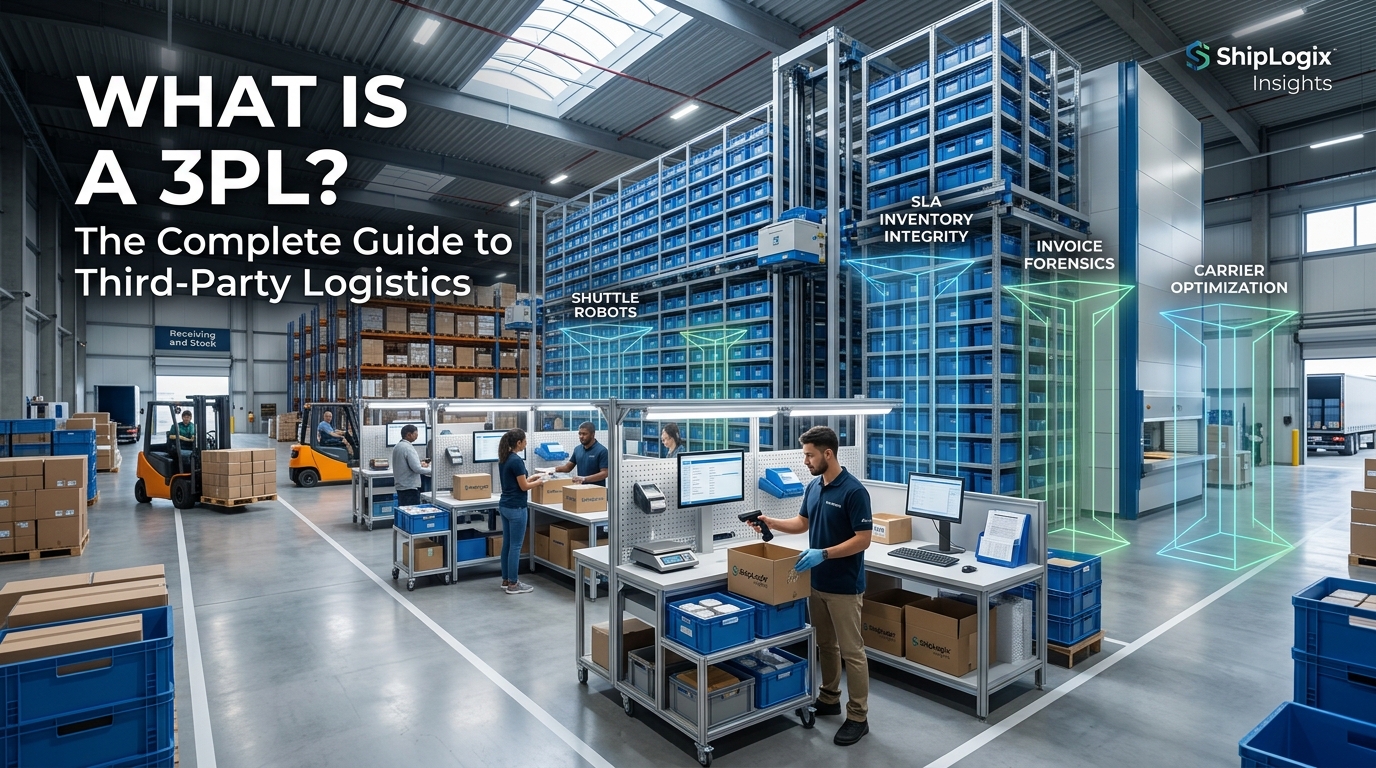
If your e-commerce brand is scaling faster than your garage, spare room, or local warehouse space can handle, you have likely run into the term 3PL.
At its core, a third-party logistics (3PL) provider is an external supply chain partner that manages order fulfillment, inventory storage, packing, and carrier shipping on behalf of e-commerce businesses and merchants. Instead of leasing real estate, hiring warehouse staff, and negotiating carrier contracts yourself, outsourcing to a modern 3PL allows you to turn fulfillment into an automated, scalable operational engine.
This comprehensive guide breaks down how third-party logistics works, what services 3PLs cover, how the 1PL through 5PL model operates, and how to determine if partnering with a fulfillment provider is right for your business.
How Third-Party Logistics Works: Step-by-step
A 3PL acts as the execution backbone between your online storefront and your customer’s doorstep. The core workflow operates across five main stages:
1. Receiving & Dock-to-Stock Putaway
Before orders can ship, your inventory must arrive at the 3PL fulfillment center. Modern providers receive inventory shipments (whether palletized freight or floor-loaded containers), perform initial counts, check for freight damage, and log the products into a Warehouse Management System (WMS). Once logged, items are allocated to specific bin, shelf, or pallet storage locations.
2. Warehousing & Real-Time Inventory Management
Your goods are stored safely in optimized, climate-appropriate warehouse spaces. Modern 3PLs sync their WMS directly with your e-commerce channels (such as Shopify, WooCommerce, Amazon, or custom ERPs). This provides real-time visibility into inventory levels across all sales channels, preventing overselling and triggering reorder points automatically.
3. Automated Order Picking & Packing
When a customer places an order online, the request routes automatically to the nearest 3PL warehouse location. Facility pickers (or automated picking robots) retrieve the requested Stock Keeping Units (SKUs) using digital pick lists and barcode verification to guarantee order accuracy. The items are then transferred to a packing station, where customized packaging, inserts, or standard protective dunnage are applied based on brand guidelines.
4. Carrier Selection & Outbound Shipping
Once packed, the 3PL generates shipping labels using dynamic carrier rate-shopping software. Because 3PLs aggregate shipping volume across hundreds or thousands of clients, they unlock access to discounted enterprise freight rates with major national carriers (like UPS, FedEx, USPS, and DHL) as well as regional parcel networks. The parcel is scanned, sorted, and handed off for last-mile delivery.
5. Reverse Logistics & Returns Processing
Managing returns efficiently is essential for customer lifetime value. A full-service 3PL handles reverse logistics by receiving returned items, inspecting products for damage, restocking re-salable items to available inventory, and disposing of or refurbishing compromised merchandise based on your store policies.
The Logistics Ecosystem: 1PL vs. 2PL vs. 3PL vs. 4PL vs. 5PL
To understand where a 3PL fits, it helps to view the full logistics service spectrum:
| Party | Operational Definition | Primary Function | Ideal Business Model |
|---|---|---|---|
| 1PL (First-Party) | Self-handled internal logistics | Merchant buys, stores, and delivers goods using own vehicles and space | Local brick-and-mortar stores, boutique crafts |
| 2PL (Second-Party) | Asset-based transport carriers | Asset owners carrying freight from point A to B (airlines, trucking lines) | Direct corporate freight bookings |
| 3PL (Third-Party) | Outsourced end-to-end fulfillment | Complete handling of warehousing, pick & pack, inventory, and shipping | Growing e-commerce brands, DTC storefronts, B2B brands |
| 4PL (Fourth-Party) | Supply chain oversight & strategy | Non-asset manager orchestrating multiple 3PLs, freight lines, and tech | Enterprise conglomerates, global retail brands |
| 5PL (Fifth-Party) | E-commerce ecosystem integration | Manages entire supply chain networks using advanced AI and automation | Multi-national supply chain networks |
Core Benefits of Partnering with a 3PL Provider
Outsourcing fulfillment is rarely just about clearing floor space—it is a strategic move designed to protect profit margins and free up executive focus.
Reduced Capital Expenditure & Variable Costs
Leasing a commercial warehouse requires multi-year lease commitments, utility overhead, security infrastructure, material handling equipment (like forklifts and shelving), and dedicated management. A 3PL converts those heavy, fixed overhead commitments into a flexible variable cost model: you pay strictly for the storage footprint and order volume you use each month.
Access to Enterprise Carrier Discounts
Individual merchants shipping hundreds of orders per month lack the leverage needed to negotiate deep shipping discounts. 3PLs pool parcel volume across their entire client network, unlocking Tier-1 rate tiers on base shipping charges, fuel surcharges, and residential delivery penalties.
Faster Transit Times & Lower Zone Costs
Single-warehouse self-fulfillment forces distant domestic customers into higher shipping zones (Zones 6–8), resulting in 4-to-6-day transit times or expensive express shipping. Multi-node 3PL networks allow you to distribute inventory closer to high-density customer regions, making 2-day ground delivery standard while keeping shipping costs low.
Unlocked Focus for Business Growth
Every hour a founder or team member spends building boxes, managing warehouse staff, or filing carrier claims is time stolen from marketing, product engineering, and customer acquisition. Outsourcing logistics allows leadership to concentrate on core revenue-generating activities.
Key Questions to Ask When Evaluating a 3PL
Not all fulfillment providers operate at the same caliber. Before signing a master services agreement (MSA), evaluate prospective logistics partners on these four criteria:
- 1. What is your native tech stack? Does the provider’s WMS integrate natively with your sales platforms (Shopify, Amazon, ERPs) without requiring costly custom middleware or manual CSV uploads?
- 2. How are SLAs contractually defined? Look for precise guarantees on same-day order cutoff times (e.g., 2:00 PM local time), dock-to-stock turnaround limits (≤24 hours), and minimum order accuracy benchmarks (≥99.8%).
- 3. What is the fee structure? Ask for a complete breakdown of pick/pack fees, storage footprint calculations, receiving rates, and carrier pass-through discounts to identify potential hidden fees or dimensional weight (DIM) padding.
- 4. What are the shrinkage allowances? Review contract clauses regarding lost or damaged goods. Ensure the provider maintains realistic inventory accuracy thresholds (≥99.5%) and clearly defines financial liability for discrepancies.
Modern E-Commerce Fulfillment with ShipLogix
Navigating third-party logistics should give you confidence, not create operational confusion or hidden invoice line items.
At ShipLogix, we provide scaling e-commerce brands with transparent, technology-driven fulfillment services. From seamless multi-channel platform integrations and real-time inventory management to enterprise carrier discounts and strict same-day SLAs, our network helps you deliver an exceptional customer experience on every order.
Ready to streamline your fulfillment operations?
Contact the ShipLogix team today to discuss your fulfillment strategy, explore our network capabilities, and receive a customized logistics plan for your brand.


Hi, this is a comment.
To get started with moderating, editing, and deleting comments, please visit the Comments screen in the dashboard.
Commenter avatars come from Gravatar.