
Imagine this.
Your manufacturer finishes production on time.
Your freight arrives exactly when expected.
Inventory reaches Amazon’s fulfillment network.
Everything appears to be on schedule.
Then you receive a notification:
Your shipment has been delayed because it doesn’t comply with Amazon’s inbound requirements.
The problem wasn’t your product.
It wasn’t your supplier.
It wasn’t your carrier.
It was the preparation.
For many Amazon sellers, the most expensive fulfillment mistakes happen before inventory ever reaches an Amazon fulfillment center. Missing labels, incorrect packaging, poor carton preparation, or overlooked compliance requirements can delay receiving, increase handling costs, or even result in inventory being refused.
That’s why successful Amazon sellers don’t think of FBA prep as a final step.
They treat it as a quality-control process.
Amazon FBA Prep Is More Than Applying Labels
Many new sellers assume Amazon FBA prep simply means placing a barcode on a product.
In reality, FBA preparation is a collection of inbound requirements that help Amazon receive, identify, store, and fulfill inventory accurately.
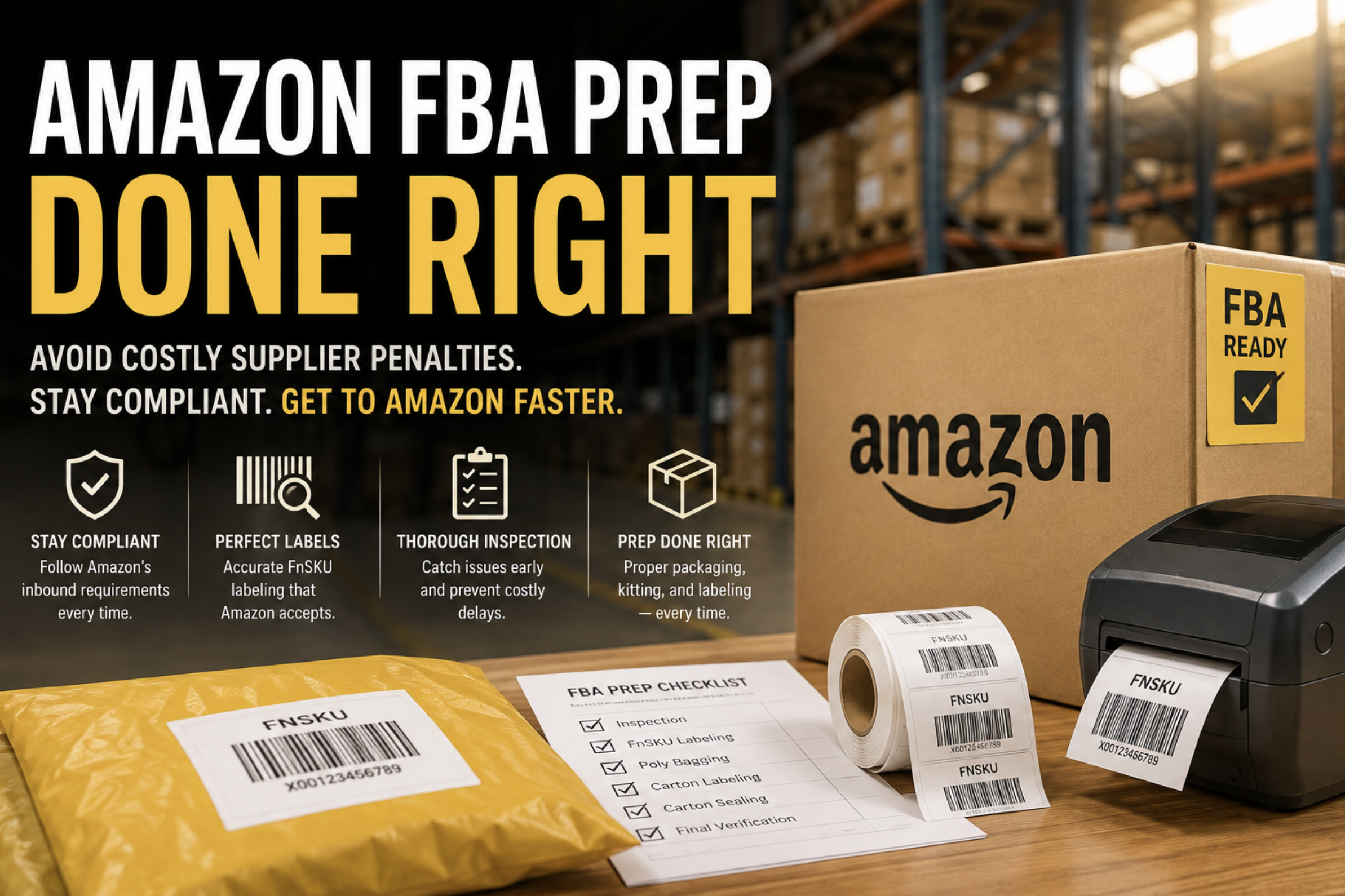
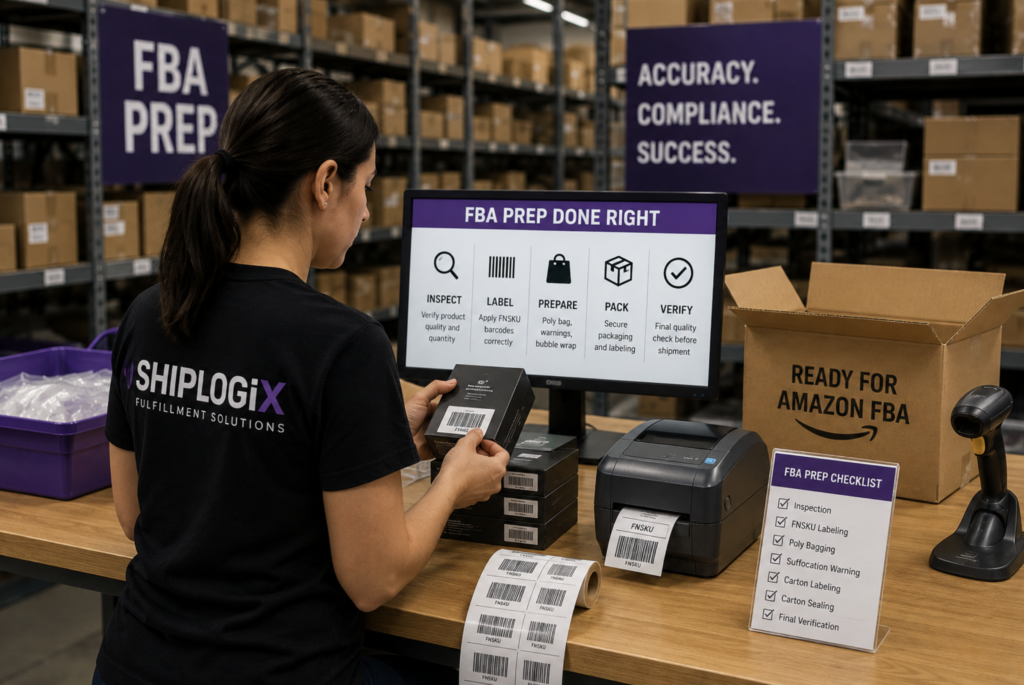
Depending on the product, preparation may include:
- Product inspections
- FnSKU barcode labeling
- Poly bagging
- Bubble wrapping
- Suffocation warning labels
- Expiration date labeling
- Carton labeling
- Carton content verification
- Bundling and kitting
- Case-pack verification
Every shipment should be reviewed against Amazon’s current FBA packaging and preparation requirements before leaving the warehouse.
The Cost of Small Mistakes
Amazon’s fulfillment network processes enormous volumes of inventory every day.
Standardized inbound procedures help keep that network efficient.
When shipments arrive with missing labels, incorrect packaging, or preparation issues, Amazon may apply additional handling, delay receiving, require corrective services, or reject shipments depending on the circumstances and the seller’s account settings.
Even seemingly minor errors can create larger business problems.
For example:
- Inventory becomes unavailable while corrections are made.
- Product launches are delayed.
- Advertising campaigns continue while inventory can’t be purchased.
- Best Seller Rank can be affected if stock isn’t available when expected.
- Customer demand shifts to competing listings.
A preparation mistake isn’t always expensive because of the fee itself.
It’s expensive because of everything that happens while inventory sits unavailable.
FnSKU Labels: The Barcode That Identifies Your Inventory
One of the most important elements of FBA labeling compliance is the Fulfillment Network Stock Keeping Unit (FnSKU).
Unlike a manufacturer barcode, an FnSKU identifies inventory within Amazon’s fulfillment network and links products to the correct seller.
Amazon requires the barcode to be readable and placed where it can be scanned without interference. Existing manufacturer barcodes may also need to be covered when Amazon requires inventory to be identified by the FnSKU instead.
Applying the correct label sounds straightforward.
Applying the wrong one to 5,000 products isn’t.
That’s why experienced FBA prep warehouses typically include barcode verification as part of their quality-control process instead of treating labeling as a repetitive manual task.
Why Product Inspections Matter Before Amazon Ever Sees the Shipment
Receiving inventory directly from a manufacturer doesn’t guarantee every unit arrives exactly as expected.
Packaging damage.
Printing defects.
Incorrect quantities.
Mixed SKUs.
Damaged cartons.
Label inconsistencies.
These issues are far easier to correct before inventory enters Amazon’s network than after.
An inspection process allows businesses to identify potential problems while products are still under their control rather than discovering them after shipment.
Depending on the product and customer requirements, inspections may include:
- Quantity verification
- Packaging condition
- Barcode confirmation
- Product appearance
- Carton integrity
- Bundle verification
- Label placement
Finding one issue before shipping is considerably easier than correcting hundreds of products after they’ve already been delivered.
Compliance Is a Moving Target
One challenge many sellers underestimate is that Amazon periodically updates its fulfillment policies, packaging standards, and inbound workflows.
Requirements can vary depending on product category, packaging type, fulfillment program, or operational changes.
Rather than relying on an old checklist, sellers should verify current requirements using Amazon’s official FBA documentation before preparing inventory.
Processes that worked last year may not fully satisfy current requirements.
Treating compliance as an ongoing process—not a one-time setup—helps reduce unnecessary disruptions.
The Hidden Value of an Amazon FBA Prep Warehouse
Many businesses begin by preparing inventory themselves.
That approach often works when shipment volume is relatively low.
As order volume grows, preparation becomes increasingly time-consuming.
Products must be received.
Inspected.
Counted.
Labeled.
Bundled.
Packed.
Verified.
Documented.
Coordinated with inbound shipping.
At some point, founders and operations teams face a decision.
Should internal staff continue spending valuable time preparing inventory?
Or should that work move to a specialized Amazon FBA prep warehouse built for those workflows?
The answer depends on volume, operational priorities, and available resources.
For many growing brands, outsourcing preparation allows internal teams to focus on sourcing products, marketing, customer acquisition, and business growth rather than warehouse tasks.
Questions to Ask Before Choosing an FBA Prep Partner
Not every prep provider offers the same services.
Before selecting one, ask questions such as:
- Do you inspect inventory before labeling?
- How do you verify FnSKU accuracy?
- Can you perform kitting and bundling?
- How are damaged products documented?
- Do you photograph discrepancies?
- Can you handle oversized or fragile products?
- What quality-control process is followed before shipment?
- How do you stay current with Amazon’s preparation requirements?
A reliable partner should be able to explain its workflow—not simply list the services it offers.
Building a Process That Scales
Many fulfillment problems don’t begin with Amazon.
They begin long before inventory reaches an Amazon fulfillment center.
The businesses that scale successfully usually rely on documented systems rather than last-minute preparation.
That includes:
- Standard operating procedures
- Barcode verification
- Inspection checklists
- Packaging standards
- Compliance reviews
- Shipment documentation
The objective isn’t simply avoiding mistakes.
It’s creating a repeatable process that consistently delivers inventory ready for Amazon’s network.
Where ShipLogix Fits
Preparing inventory for Amazon requires accuracy, consistency, and attention to detail.
ShipLogix provides Amazon FBA prep services designed to help growing brands prepare inbound inventory according to Amazon’s current requirements. Services include inspection, FnSKU labeling, packaging, kitting, and shipment preparation before inventory enters Amazon’s fulfillment network.
For businesses shipping larger volumes or managing multiple suppliers, having a dedicated FBA preparation partner can simplify operations while reducing the risk of costly preparation errors.
The Bottom Line
Selling through Amazon is competitive enough without preventable inbound problems slowing your inventory before it reaches customers.
A missing label.
An incorrect carton.
An overlooked packaging requirement.
Each seems minor on its own.
Together, they can create delays that ripple across your entire business.
The most successful Amazon sellers don’t leave compliance to chance.
They build systems that make accuracy repeatable.
If your business is spending too much time preparing inventory—or you’re looking to reduce the risk of inbound compliance issues—ShipLogix can help streamline your Amazon FBA prep process with professional inspection, labeling, packaging, and fulfillment support so your inventory arrives ready for Amazon’s network.

Hi, this is a comment.
To get started with moderating, editing, and deleting comments, please visit the Comments screen in the dashboard.
Commenter avatars come from Gravatar.