
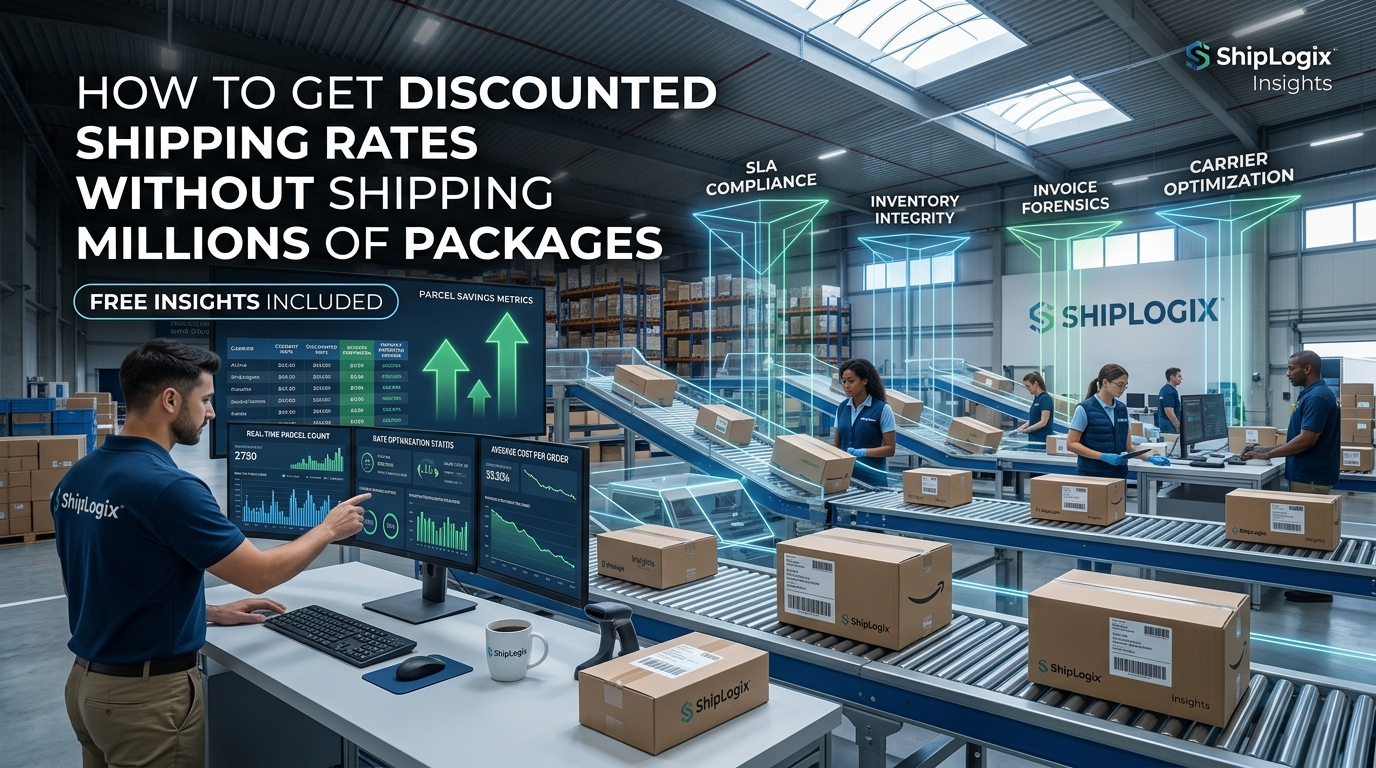
For growing e-commerce merchants, parcel shipping spend often feels like a stacked game. Major national carriers like UPS, FedEx, and DHL reserve their lowest Tier-1 rates, waived fuel surcharges, and custom accessorial discounts for enterprise conglomerates shipping millions of parcels each year.
If your store ships 500 to 10,000 packages a month, operating on entry-level commercial tier rates can quietly consume 20% to 35% of your gross revenue.
However, hitting high-volume enterprise status isn’t the only way to lower your shipping costs. Independent e-commerce brands can access enterprise-tier discounts, reduce parcel spend, and protect profit margins without shipping millions of packages.
The Carrier Pricing Game: How Rates Are Actually Calculated
Understanding carrier rate structures reveals why small and mid-sized shippers overpay. National carriers price parcel shipping based on four core variables:
- Daily Volume Commitment: Aggregate package count per week determines your baseline discount tier.
- Billable Weight vs. Dimensional Weight: The package’s physical weight compared to its volumetric footprint (Length×Width×Height÷139).
- Shipping Zone Distance: The geographic span from fulfillment origin to final delivery destination (Zones 2 through 8).
- Accessorial Surcharges: Line-item penalties such as residential delivery fees, fuel surcharge adjustments, address corrections, and peak season surcharges.
When shipping low-to-moderate volumes independently, carriers grant modest base rate discounts but leave expensive accessorial surcharges intact.
4 Proven Strategies to Secure Enterprise Shipping Discounts
1. Leverage Aggregated Volume Through a 3PL Network
The single most effective path to Tier-1 shipping discounts is co-loading volume through a third-party logistics (3PL) provider.
Instead of negotiating with carriers individually based on your store’s standalone order volume, a 3PL aggregates parcel volume across its entire client base—processing tens of millions of packages annually.
- The Result: The 3PL passes its pre-negotiated enterprise rate tiers, reduced fuel surcharges, and discounted residential fees directly to your account.
- The Financial Impact: Per-package freight savings ($1.50 to $4.50+ saved per parcel) often completely offset the 3PL’s per-order pick and pack fee.
2. Implement Regional Carrier Hybrid Routing
Relying exclusively on a single national carrier limits your rate negotiation power. Regional parcel carriers (such as OnTrac, Pitney Bowes, and regional ground networks) operate localized delivery networks with lower overhead costs.
| Carrier Strategy | Coverage Scope | Primary Cost Benefit | Best Parcel Profile |
|---|---|---|---|
| National Carriers (UPS/FedEx) | Nationwide & International | Deep discounts on heavy freight and long-distance shipping | Packages >5 lbs, Zone 5–8 express shipments |
| USPS Ground Advantage | Nationwide | Zero residential fees, low light-package rates | Lightweight DTC orders under 2 lbs |
| Regional Parcel Networks | Specific geographic hubs | Lower base rates, reduced fuel surcharges, faster regional transit | High-density regional customer clusters (Zone 2–4) |
3. Renegotiate Carrier Contracts on Specific Accessorials
If you fulfill in-house and manage your own carrier agreements, do not focus solely on base rate discounts. Carriers are often more flexible on accessorial fees than base freight rates.
Prioritize negotiating these specific line items during contract reviews:
- Residential Delivery Surcharges: Request a flat percentage discount on residential fees, which frequently add $4.00 to $5.50+ per package.
- Fuel Surcharge Capping: Negotiate a capped or discounted fuel surcharge index.
- Dimensional Weight Divisor: Ask for a custom DIM divisor (e.g., shifting from the standard 139 to 166 or 175) to reduce volumetric billing penalties on larger, lighter boxes.
4. Optimize Inventory Placement to Shrink Shipping Zones
Shipping distance directly dictates parcel expense. A package traveling to Zone 7 or 8 costs up to 60% more than the same package traveling to Zone 2 or 3.
Distributing inventory across multiple regional fulfillment nodes puts your products closer to high-density customer hubs. Shrinking your average delivery distance down to Zones 2, 3, and 4 drastically lowers base freight costs while providing standard 2-day ground delivery without paying for expensive air shipping.
Discounted Rates Opportunity Assessment
Use this checklist to identify where your brand is currently leaving freight savings on the table:
- [ ] Carrier Diversification: Your fulfillment setup automatically routes packages across multiple national and regional carriers based on real-time cost shopping.
- [ ] Accessorial Discounts: Your carrier contract includes negotiated discounts on residential delivery fees, fuel surcharges, and peak penalties.
- [ ] DIM Optimization: Your package dimensions are tailored to your product line to avoid volumetric weight penalties.
- [ ] Zone Reduction: Over 70% of your domestic orders ship within Zones 2 through 4.
- [ ] Volume Pooling: You leverage aggregated enterprise volume through a logistics partner or shipping consortium.
Savings Insight: Unchecking two or more items above indicates your brand can likely reduce per-package shipping spend by 15% to 30% using aggregated pricing models.
Unlock Enterprise Rates with ShipLogix
You don’t need to ship millions of packages to access the logistics rates, speed, and efficiency of Fortune 500 retailers.
At ShipLogix, we level the playing field for growing e-commerce brands. By pooling order volume across our fulfillment network, we provide immediate access to enterprise Tier-1 carrier discounts, automated multi-carrier rate shopping, and strategic regional distribution.
Ready to stop overpaying on parcel shipping?
[Contact the ShipLogix team today] for a complimentary shipping invoice audit. We’ll analyze your current carrier bills and show you exactly how much you can save with enterprise volume pricing.


0 Comments