
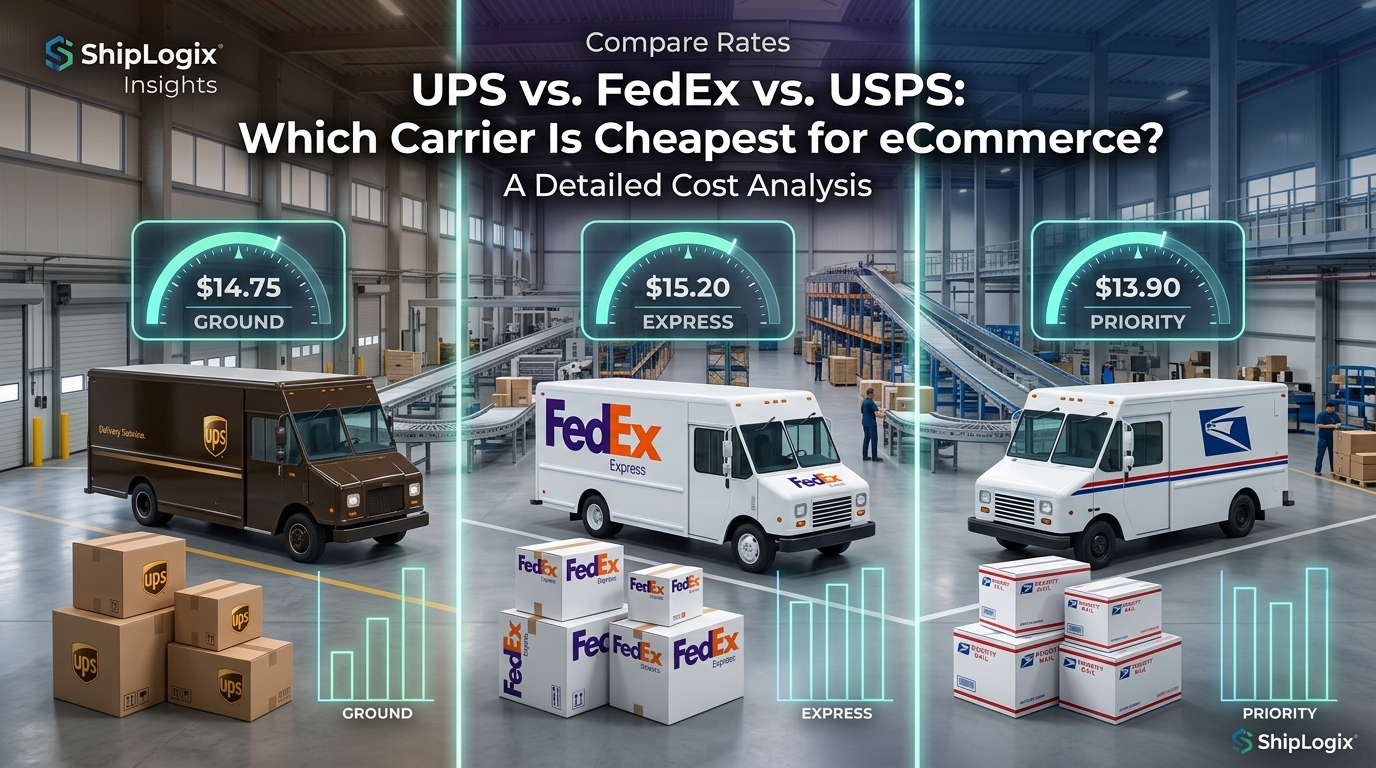
Every year, e-commerce brands lose thousands of dollars in gross profit by assuming one carrier holds a universal monopoly on the lowest shipping rates.
The reality of parcel logistics is far more nuanced: no single carrier is the cheapest across all weights, zones, and delivery speeds.
While published list rates between UPS, FedEx, and USPS appear competitive at first glance, line-item surcharges, volumetric billing adjustments, and package profiles drastically alter your true landed cost per order. Selecting the wrong carrier for specific order profiles can quickly inflate your total shipping spend by 15% to 30%.
This deep-dive carrier analysis evaluates real-world pricing mechanics, hidden line-item penalties, and optimal shipment profiles across UPS, FedEx, and USPS so you can optimize your carrier routing strategy.
At a Glance: Carrier Strengths & Sweet Spots
Understanding where each carrier maintains a structural pricing advantage is the foundation of cost-effective parcel fulfillment:
| Carrier & Primary Service | Ideal Package Profile | Key Pricing Advantage | Hidden Cost Warning |
|---|---|---|---|
| USPS Ground Advantage | Lightweight parcels under 1–3 lbs; PO Box and APO destinations | Zero residential surcharges; lowest base rate for lightweight DTC orders | Strict $200 non-compliance penalty for unauthorized oversized parcels |
| UPS Ground | Dense, medium-to-heavy parcels (5–50+ lbs); commercial B2B orders | Exceptional ground reliability; highly competitive rates on heavy packages | $6.50+ residential delivery surcharge per package plus variable fuel adjustments |
| FedEx Home Delivery | Regional ground parcels requiring weekend transit (Saturday/Sunday) | Standard weekend residential delivery included without extra delivery fees | Steep residential surcharges ($6.45+) and aggressive peak season fees |
3 Core Variables That Determine Your True Shipping Cost
1. The Residential Surcharge Trap
Base freight rates tell only half the story. When shipping to consumer residential addresses, national private carriers assess significant line-item penalties:
- UPS & FedEx: Both private carriers impose residential delivery surcharges ranging from $6.45 to $6.50+ per parcel, before applying variable fuel surcharges.
- USPS: The United States Postal Service charges $0 in residential surcharges. A $9.00 USPS Ground Advantage shipment costs exactly $9.00 at the residential door, whereas a $9.00 base rate from UPS or FedEx instantly escalates to over $16.00 once residential and fuel surcharges land.
2. Dimensional Weight (DIM) Divisor Parity
Carriers calculate billable weight based on whichever is greater: actual physical weight or volumetric size (Length×Width×Height÷DIM Divisor).
Billable DIM Weight (lbs)=139Length (in)×Width (in)×Height (in)
All three major carriers now enforce a standard 139 DIM divisor across commercial ground tiers. Shipping a lightweight, bulky product in an oversized box triggers heavy dimensional weight penalties across UPS, FedEx, and USPS alike.
3. Shipping Zone Distance Mechanics
Parcel rates scale progressively based on distance. Shipping zones range from Zone 2 (local transit within 150 miles) to Zone 8 (cross-country transit over 1,800 miles).
                      SHIPPING ZONE DISTANCE SCALE

  Zone 2            Zone 4            Zone 6            Zone 8
(0-150 Miles)    (301-600 Miles)  (1,001-1,400 Miles)  (1,801+ Miles)
   [ $ ]            [ $$ ]            [ $$$ ]           [ $$$$ ]
While USPS holds a commanding pricing advantage on Zone 2 through Zone 5 shipments under 5 lbs, UPS Ground and FedEx Ground become significantly cheaper for long-distance Zone 7 and Zone 8 shipments weighing over 10 lbs.
Real-World Shipping Scenarios: Who Wins Where?
Scenario A: Lightweight DTC Products (Under 1 lb)
- Winner: USPS Ground Advantage
- Analysis: For small, lightweight items (apparel, cosmetics, supplements), USPS is virtually unbeatable. Published commercial rates start well below $6.00 with zero residential surcharges. Neither UPS Ground nor FedEx Ground can compete on sub-1-pound residential parcels due to their minimum base charges and residential fees.
Scenario B: Mid-Weight Domestic Orders (3 lbs to 10 lbs)
- Winner: UPS Ground / FedEx Home Delivery (Tie)
- Analysis: UPS and FedEx trade leads by pennies on base rates. However, if your order is going to a commercial business address, UPS and FedEx easily outperform USPS Priority Mail on speed and cost. For residential deliveries in this weight class, hybrid services like UPS Ground Saver or FedEx Ground Economy often provide the best balance between price and tracking visibility.
Scenario C: Heavy or Bulk Freight (15 lbs to 50+ lbs)
- Winner: UPS Ground
- Analysis: As package weight exceeds 15 lbs, USPS rates scale sharply upward, making postal options cost-prohibitive. UPS Ground provides the lowest landed cost for heavy products (gym equipment, beverage cases, bulk home goods), backed by superior network tracking and commercial reliability.
Carrier Selection Decision Scorecard
Use this matrix to assign the right carrier to your product line:
- [ ] Lightweight Parcels (< 2 lbs): Route via USPS Ground Advantage to eliminate residential surcharges completely.
- [ ] Heavy Parcels (> 10 lbs): Route via UPS Ground to capitalize on heavy-freight volume discounts.
- [ ] Weekend Residential Speed: Route via FedEx Home Delivery for native Saturday and Sunday delivery coverage.
- [ ] PO Boxes & Military Addresses: Route exclusively via USPS, as UPS and FedEx cannot access USPS postal boxes.
- [ ] High-Value Expedited Orders: Route via UPS Next Day Air or FedEx Express for guaranteed delivery SLAs.
Routing Insight: Relying on a single carrier across all order profiles guarantees you are overpaying on at least 20% to 30% of your daily outbound shipments.
Multi-Carrier Routing Made Simple with ShipLogix
Winning at e-commerce shipping doesn’t mean picking one carrier—it means automatically routing every individual order to the cheapest, fastest carrier in real time.
At ShipLogix, our automated fulfillment engine integrates directly with your store, dynamically rate-shopping every order across UPS, FedEx, and USPS based on box dimensions, destination zone, and real-time surcharge metrics. By combining dynamic multi-carrier software with our pre-negotiated Tier-1 carrier volume discounts, we ensure your brand always ships at the absolute lowest landed cost.
Ready to eliminate carrier rate guesswork and reclaim your gross margins?
[Contact the ShipLogix team today] for a complimentary rate analysis and discover how much dynamic carrier routing can save your business.


Hi, this is a comment.
To get started with moderating, editing, and deleting comments, please visit the Comments screen in the dashboard.
Commenter avatars come from Gravatar.