
If you have an uneasy feeling that your third-party logistics (3PL) provider is quietly eroding your margins, you are likely right. 3PL relationships rarely fail overnight in a dramatic breakdown. Instead, they deteriorate through micro-losses: a $1.50 unexplained line-item surcharge here, a 0.8% uptick in mispicks there, and carrier residential surcharges passed through without audit or discount.
Over a quarter, these discrepancies can quietly slice 3% to 8% off your bottom line.
Evaluating your warehouse partner isn’t just about reviewing end-of-month invoices—it requires a systematic operational audit. Whether you are assessing an incumbent partner to repair a breaking relationship or learning how to choose a 3PLthat aligns with your long-term growth, this step-by-step audit framework and checklist will help you surface hidden costs, measure true service level agreement (SLA) compliance, and regain control of your supply chain.
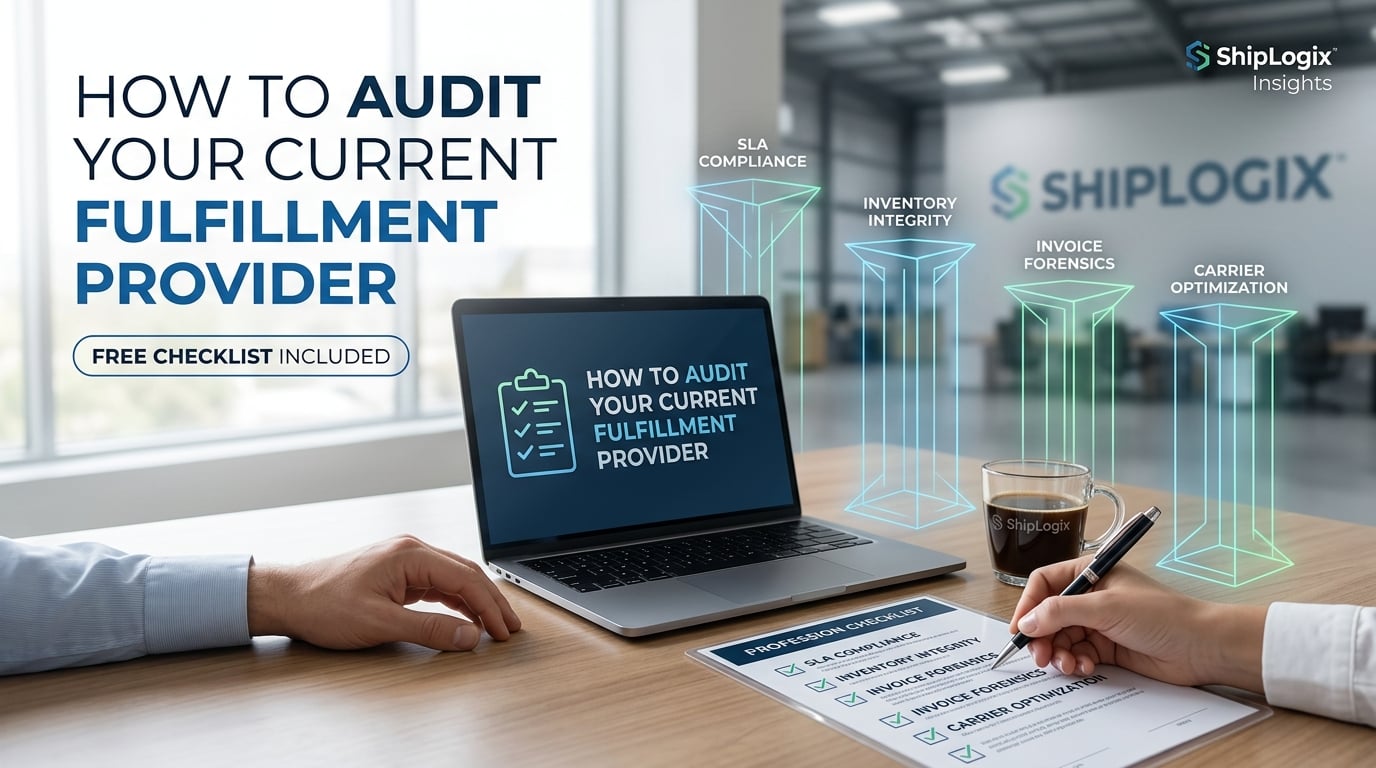
The 4 Critical Pillars of a Fulfillment Audit
An effective 3PL audit evaluates four distinct, interconnected layers of your logistics operations:
- 1. SLA Compliance & Accuracy: Measuring same-day cutoff consistency, order picking accuracy, dock-to-stock turnaround, and return processing speeds.
- 2. Inventory Integrity: Tracking physical-to-WMS stock accuracy, shrinkage allowances, and damage ratios occurring inside the warehouse.
- 3. Invoice Forensics: Auditing storage calculations, receiving fees, dimensional weight rounding, and administrative line-item creep.
- 4. Carrier Optimization: Evaluating shipping zone performance, carrier pass-through discounts, dynamic routing efficiency, and address correction penalties.
Deep-Dive Operational Breakdown
Pillar 1: Order Accuracy & SLA Compliance
A 99% order accuracy rate sounds impressive until you process 10,000 orders a month. That 1% failure rate represents 100 disappointed customers, 100 replacement shipments, double the shipping costs, and dozens of hours logged by customer support.
When auditing SLAs, measure performance against these specific industry benchmarks:
| Metric | Industry Benchmark | Danger Zone | How to Calculate |
| On-Time Order Fulfillment | $\ge 99.5\%$ | $< 98.0\%$ | $(\text{Orders Shipped Within SLA} \div \text{Total Orders Received}) \times 100$ |
| Order Picking Accuracy | $\ge 99.8\%$ | $< 99.0\%$ | $(\text{Correctly Picked Orders} \div \text{Total Orders Picked}) \times 100$ |
| Dock-to-Stock Time | $\le 24 \text{ hours}$ | $> 48 \text{ hours}$ | $\text{Timestamp (Putaway)} – \text{Timestamp (Unloaded)}$ |
| Return Processing Time | $\le 48 \text{ hours}$ | $> 5 \text{ business days}$ | $\text{Timestamp (Inspected/Restocked)} – \text{Timestamp (Delivered)}$ |
Audit Action Item: Pull a random sample of 200 orders from the past 90 days. Cross-reference the order timestamp in your e-commerce platform against the carrier initial scan time, rather than relying on the 3PL’s internal “label generated” timestamp.
Pillar 2: Inventory Integrity & Shrinkage
Unexplained inventory variance directly impacts your balance sheet. Many standard 3PL contracts include an “allowable shrinkage clause”—often between 1% and 2% of total inventory value—meaning the provider isn’t liable for losses under that threshold.
- Cycle Count Frequency: Does your 3PL perform continuous wall-to-wall cycle counts, or do they only count when a discrepancy forces a stockout?
- Inventory Accuracy Target: True physical-to-WMS (Warehouse Management System) accuracy should sit at 99.5% or higher.
- Damaged Goods Ratio: Track damage rates at receiving versus damage incurred during storage or outbound picking. High outbound damage often indicates inadequate dunnage or poor packing guidelines.
Pillar 3: Invoice Forensics & Hidden Fees
3PL pricing structures are notoriously complex. Unpacking invoice line items frequently uncovers fee creep—charges that slowly appear or increase over time without formal contract amendments.
Examine your last three monthly invoices line-by-line for these common hidden costs:
- Dimensional Weight (DIM) Padding: Is the warehouse rounding package dimensions up to the next inch on every axis? A $10\text{”}\times10\text{”}\times10\text{”}$ box rounded to $11\text{”}\times11\text{”}\times11\text{”}$increases dimensional weight from 6 lbs to 8 lbs (using a standard 139 DIM divisor), resulting in higher shipping charges across thousands of parcels.
- Receiving Surcharges: Check for unexpected fees added for non-palletized inventory, floor-loaded containers, or unannounced deliveries that exceed agreed hourly receiving rates.
- Account Management & Tech Fees: Verify that monthly integration, software access, or account support fees align with your master services agreement (MSA).
Pillar 4: Carrier Management & Zone Optimization
Shipping typically accounts for 60% to 70% of total fulfillment spend. Even if your 3PL’s pick-and-pack rates are low, inefficient carrier routing will inflate overall costs.
- Zone Distribution: Are your packages traveling through unnecessary shipping zones? If more than 30% of your domestic packages are shipping to Zones 6 through 8, your 3PL’s node network may be sub-optimal for your customer distribution.
- Carrier Pass-Through Discounts: Does your 3PL pass along tier-one volume discounts from major national and regional carriers, or do they mark up base freight rates?
- Surcharge Auditing: Review peak season surcharges, fuel surcharges, address correction fees, and residential delivery surcharges. Ensure address validation tools are active at checkout to prevent avoidable carrier penalties.
Interactive Fulfillment Audit Checklist
Use this structured checklist during your quarterly or annual partner review.
Section 1: Contract & SLA Verification
- [ ] On-Time Fulfillment: On-time shipping rates consistently meet or exceed MSA guarantees ($\ge 99.5\%$).
- [ ] Order Cutoff Integrity: Daily order cutoff times (e.g., 2:00 PM local) are strictly maintained.
- [ ] Pick & Pack Quality: Order pick and pack error rate stays safely below $0.2\%$.
- [ ] Contractual Remedies: Clear financial credits or remedies exist and are honored for missed SLAs.
Section 2: Inventory & WMS Accuracy
- [ ] Real-Time Sync: WMS inventory counts match your e-commerce platform in real time.
- [ ] Shrinkage Control: Inventory loss/shrinkage stays below the contractually agreed allowance threshold.
- [ ] Dock-to-Stock Efficiency: Inbound freight is unpacked, inspected, and put away within 24 hours.
- [ ] Traceability: Serialized or lot-tracked inventory items are properly logged and searchable.
Section 3: Invoicing & Cost Control
- [ ] DIM Accuracy: Package outer dimensions match physical box sizes with no artificial DIM rounding.
- [ ] Storage Footprint: Storage fees accurately reflect actual bin, shelf, or pallet footprints used.
- [ ] Line-Item Verification: Invoices contain zero undocumented administrative or operational surcharges.
- [ ] Material Billing: Custom packaging, inserts, and dunnage costs match agreed contract rates.
Section 4: Carrier & Delivery Performance
- [ ] Dynamic Routing: Orders route dynamically to the lowest-cost, fastest shipping option per lane.
- [ ] Regional Carriers: Regional carrier networks are utilized wherever cost savings apply.
- [ ] Address Validation: Automated checkout address validation is enabled to prevent carrier penalty fees.
- [ ] Claims Management: Freight claims for lost or damaged transit items are promptly filed and credited.
Interpreting Your Audit Results
Once you have gathered the data, tally your findings across all four pillars:
- Score 90%–100% (Operational Excellence): Your 3PL is a strong strategic partner. Focus your efforts on joint optimizations like custom packaging or expanded zone coverage.
- Score 75%–89% (Needs Correction): Operational friction is reducing your profit margins. Schedule an executive review to present your audit data, establish clear corrective action plans (CAPs), and request credits for verified billing discrepancies or missed SLAs.
- Score Below 75% (Critical Breakdown): Your current provider is actively hindering your brand’s growth and margin stability. It is time to issue a formal RFP and evaluate alternative logistics providers.
Transitioning to a Transparent Fulfillment Partner
Auditing your provider shouldn’t feel like a constant struggle against hidden line items or unkept promises. Modern logistics requires real-time data visibility, automated SLA tracking, and straightforward pricing structures.
At ShipLogix, we built our fulfillment network on total operational transparency. From live WMS inventory syncing and automated carrier selection to clear, straightforward billing with zero hidden surcharges, we help growing brands protect their customer experience and their bottom line.
Ready to see how your current logistics costs stack up?
[Contact the ShipLogix team today] for a complimentary, line-by-line fulfillment invoice audit. We will analyze your shipping profile, uncover hidden carrier surcharges, and show you exactly where you can reclaim margin.


Hi, this is a comment.
To get started with moderating, editing, and deleting comments, please visit the Comments screen in the dashboard.
Commenter avatars come from Gravatar.