
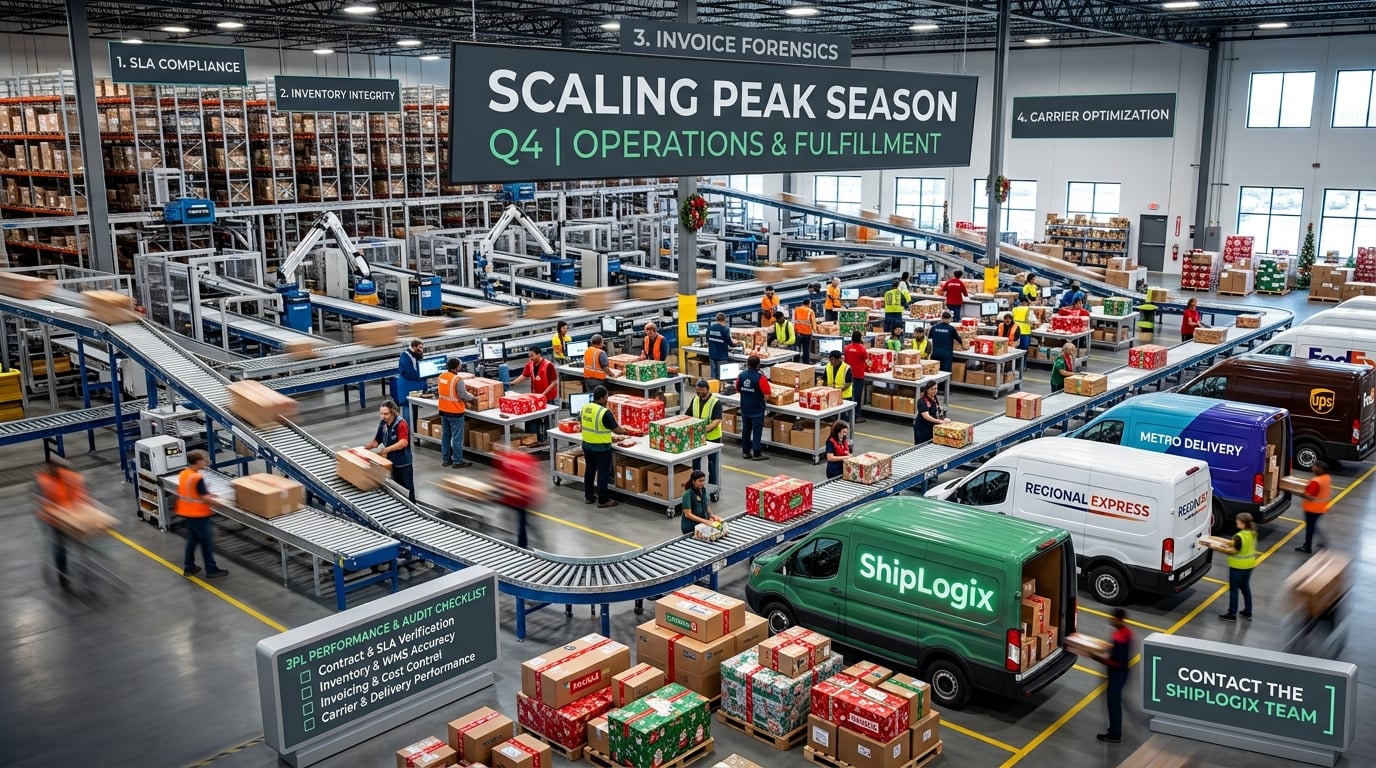
Every year, Q4 tests the limits of e-commerce operations. The fourth quarter compresses a massive portion of annual retail revenue into a high-stakes, eight-week window between Halloween and New Year’s Day. For growing brands, this volume surge brings both massive sales potential and extreme operational vulnerability.
When order volumes spike 300% to 500% overnight, existing fulfillment workflows break. Carrier capacity caps lock in, warehouse pick-and-pack speeds slow under strain, and stockout errors cascade into negative customer reviews. Surviving Q4 requires shifting from reactive firefighting to proactive, structured capacity planning.
The Anatomy of Q4 Fulfillment Failures
Fulfillment breakdowns during peak season rarely stem from a single error. Instead, they result from systemic vulnerabilities triggered by rapid volume acceleration.
       [ Surge in Order Volume ]
                   │
                   ▼
     ┌───────────────────────────┐
     │  Stockout & Allocation    │
     │        Mismatches         │
     └─────────────┬─────────────┘
                   │
                   ▼
     ┌───────────────────────────┐
     │   Warehouse Bottlenecks   │
     │ (Pick/Pack Rate Drops)    │
     └─────────────┬─────────────┘
                   │
                   ▼
     ┌───────────────────────────┐
     │  Carrier Capacity Caps    │
     │  & Surcharges Activated   │
     └─────────────┬─────────────┘
                   │
                   ▼
     ┌───────────────────────────┐
     │ Customer Service Backlog  │
     │   & Inventory Miscounts   │
     └───────────────────────────┘
- Stockout and Allocation Mismatches: Inaccurate inventory forecasting leaves top-selling SKUs out of stock while over-allocating capital to slow-moving inventory.
- Warehouse Bottlenecks: Manual picking processes and inadequate staging areas create severe fulfillment backlogs as daily order targets double or triple.
- Carrier Capacity Caps & Surcharges: Regional and national parcel carriers enforce strict daily package limits, levying peak season surcharges that compress profit margins.
- Customer Service Backlog: Delayed tracking updates and lost packages flood support teams with “Where Is My Order?” (WISMO) inquiries, overwhelming customer care teams.
4 Core Pillars of Peak Season Readiness
To maintain fast delivery SLAs and preserve margins during peak season, fulfillment strategies must address four core operational areas well before the Q4 rush begins.
| Operational Pillar | Key Risk Factor | Strategic Solution | Implementation Timeline |
|---|---|---|---|
| Inventory Positioning | Single-origin shipping delays | Multi-node inventory distribution | 90–120 days pre-Q4 |
| Carrier Management | Carrier capacity caps & surcharges | Multi-carrier regional routing | 60–90 days pre-Q4 |
| Warehouse Operations | Pick/pack throughput bottlenecks | Batch-picking & dedicated staging | 30–60 days pre-Q4 |
| Tech Integration | Real-time inventory sync lag | Unified WMS/OMS API integration | 30 days pre-Q4 |
Strategic Blueprint: Operational Execution
1. Optimize Inventory Distribution
Shipping all Q4 orders from a single centralized warehouse exposes brands to longer transit times, higher shipping zones, and elevated carrier surcharges. Distributing inventory across key regional nodes positions high-velocity SKUs closer to end consumers.
- Reduce Zone Distance: Placing stock nearer to major metropolitan markets shifts shipments from Zone 7/8 down to Zone 2/3.
- Shorten Transit Times: Lower zone distance enables ground shipping to deliver in 1 to 2 days without paying expedited air rates.
- Mitigate Risk: Distributed inventory ensures that regional weather delays or localized carrier outages do not stall your entire fulfillment pipeline.
2. Implement Multi-Carrier Routing
Relying on a single parcel carrier during Q4 exposes your business to unexpected daily volume caps and missed pick-up windows. A multi-carrier strategy dynamically distributes package volume across national, regional, and last-mile delivery partners.
- Bypass Regional Hubs: Utilize zone skipping—consolidating parcels and trucking them directly to regional carrier hubs—to reduce transit steps and bypass overloaded central sorting facilities.
- Automate Rate & SLA Selection: Use intelligent shipping software to automatically select the optimal carrier based on real-time transit performance, destination zone, and total shipping cost.
- Diversify Carrier Mix: Combine primary parcel carriers with regional last-mile specialists to secure backup delivery capacity when volume spikes exceed standard daily allocations.
3. Streamline Warehouse Throughput
Physical warehouse operations must be optimized for maximum speed and accuracy during high-volume surges. Simple workflow adjustments significantly improve daily order processing capacity.
- Establish Fast-Pick Zones: Move top 20% high-velocity Q4 SKUs near packing stations to minimize picker travel distance.
- Transition to Batch Picking: Group similar orders into consolidated picking routes rather than picking items order-by-order.
- Pre-Assemble Promotional Kits: Pre-package popular holiday bundles and gift sets during late Q3 to turn complex assembly orders into quick pick-and-label tasks.
Turning Q4 Fulfillment into a Growth Engine
A successful peak season depends on early preparation, diversified carrier networks, and reliable warehouse technology. Brands that solve fulfillment bottlenecks before Q4 protect their margins, maintain delivery promises, and turn first-time holiday shoppers into long-term customer relationships.
ShipLogix provides the distributed fulfillment network, multi-carrier technology, and scalable logistics infrastructure required to navigate peak season volume surges. Connect with a ShipLogix logistics specialist today to audit your Q4 fulfillment strategy and lock in delivery capacity before peak season begins.


0 Comments